
supporting parents and
children to learn together


Blog: In it together – a parent/practitioner partnership approach to starting nursery or school
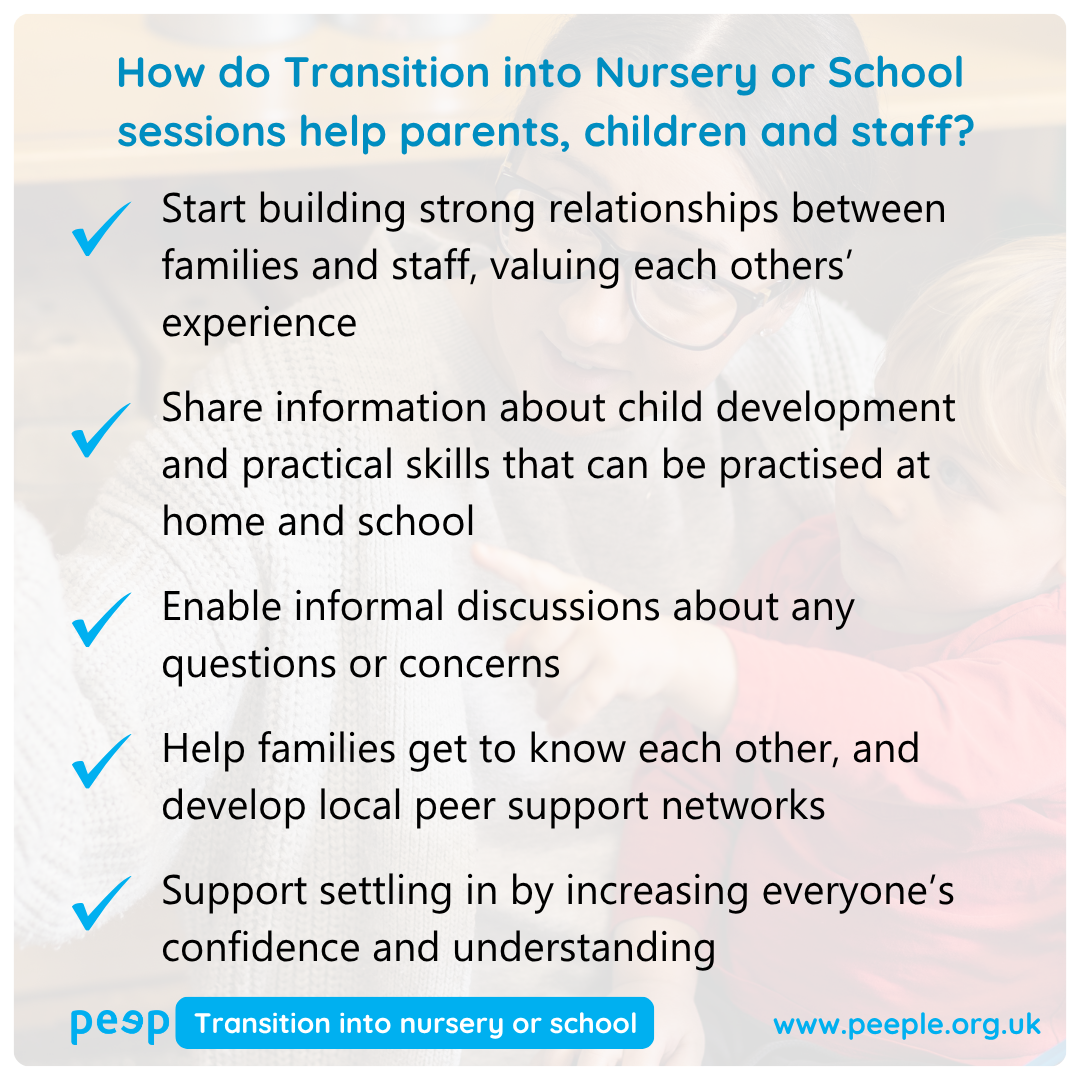 Arranging transition sessions for children and parents can feel like the early years sector equivalent of 'eat more veg': everyone agrees they’re a good idea, but fitting them in can be hard. The good news is that they’re do‑able, and they pay off - especially when they’re planned to work for families and staff.
The weeks before a child starts nursery or school are a unique window to start building a partnership that lasts all year. Much of getting ready to start at their school or nursery setting happens at home in everyday moments - talking about what will be different, practising routines, building independence. When adults feel confident and connected, children tend to settle faster and learning becomes more joined up.
Some settings already run parent-and-child Peep transition groups and swear by them. Others would like to, but face constraints. If you recognise any of the barriers below, you’re not alone:
- There isn’t time to add in 'one more thing'.
- We’re trained to work with children, not adults - it can feel daunting.
- Children will visit anyway, so we’ll see parents briefly then.
- What would we do or talk about?
- Who looks after the other children, and where would we hold it?
- We’ve invited parents before and uptake was low.
- We don’t yet have buy‑in from colleagues or senior leaders.
And yet, done well, a handful of sessions can save time later, build trust early, and give families simple ways to support learning and independence at home. That’s where the Peep Learning Together Programme (LTP) and practitioner training can help - by offering structure, materials and a tried-and-tested approach.
How Peep can help you make transition sessions workable
1. Time: it’s an investment, not an 'extra'
Time is often the biggest sticking point. But the cost of not supporting transition is real too. The latest School Readiness survey of over 1,000 school staff and 1,000 parents (Kindred Squared, 2026) reports: “Primary school staff estimate that children are missing out on 2.4 hours of daily class teaching time due to the catch‑up needs of children who are not ready for Reception.” Staff said this time is largely spent on social skills, emotional regulation and communication and language, alongside early literacy, self‑care and physical development. These things are all covered within the Learning Together programme.
A few welcoming, well‑structured sessions won’t solve every challenge - and some children will need longer‑term support - but they can shift the dial. Peep transition sessions create space for practical problem‑solving (“We tried X but…”) in a friendly, non‑judgemental group. Families leave with realistic ideas to practise at home, plus encouragement from staff and other parents.
2. Working with adults: knowing what to do (and what to say)
It’s common to feel more confident with either children or adults. Peep Learning Together training tackles this directly, and the programme gives you ready‑to‑use session plans - including talk time prompts for adults and ideas for songs, stories and simple activities to do together. You can share key information about your setting, but it’s also a chance to listen, notice worries early, and follow up if you don’t yet have an answer.
Peep handouts translate child development into everyday, doable practice: short ideas families can weave into normal life (getting dressed, snack time, story time, walking to school) - plus a simple 'why this helps'. This keeps the focus on progress, not pressure.
3. Logistics: staffing, space and fitting it around what you already do
Sessions are typically around an hour. Depending on cover and ratios, they can be led by the class teacher, a teaching/learning support assistant, or a nursery key person (with their key children attending). In some areas they’re delivered or co‑delivered by a Peep‑trained family support worker from a family hub, community organisation or local authority. They can run in the classroom, a spare room, or a local community space - and can be timed to align with existing visits (for example, feeder setting visits or when current classes are visiting their new teacher/classroom).
4. Helping parents to come along
- Make the invitation personal: a quick chat at pick‑up (of siblings or by staff at a feeder setting), a phone call, or a friendly message alongside the formal letter/email.
- Explain the 'why' in plain terms: this is about making day one easier and building routines gradually, not judging parenting.
- Remove small barriers: clear times, what to expect, whether siblings can come, and who to talk to if attendance is tricky.
- Once sessions become 'what we do here', uptake often improves year on year.
What families and staff gain from doing this early
Transition sessions help staff and families get to know each other as people, taking the edge off the first day. Children can explore and play in a safe, familiarising way, and families can practise a few key routines at home between sessions - building confidence, resilience and growing independence. Staff also learn early what helps and hinders for each family.
Parents can share what they know about their child - interests, worries, strengths, what works at home. It’s also a chance to reinforce that 'school readiness' is a shared effort: settings adapting for children as well as families practising helpful habits. Reassurance matters here, particularly (but not only) for children with special educational needs/additional support needs: development varies, and the goal is steady progress, with sensible adaptations and signposting where needed.
“The Peep group gives me lots of ideas about how to better support my daughter out with the setting” Parent
Settings using Peep Learning Together to underpin 'getting ready' sessions consistently report that children settle more quickly, parents feel more confident and engaged, and staff gain richer insights into children’s interests and needs - making learning feel more continuous between home and setting.
Getting buy‑in (and keeping it realistic)
At its heart, Peep is relationship‑based, low‑cost and flexible. It strengthens the home learning environment (shown repeatedly to improve children’s outcomes) without adding pressure, values parents as partners, and gives staff a clear structure for early connection. If you’re weighing up whether it’s worth it, consider starting small: a short series of sessions, a consistent welcome, and a few shared routines that families can practise between visits.
When transition is approached as a shared journey, everyone benefits - children, parents and practitioners alike.
“Peep gives us a shared language. Parents see that learning doesn’t just happen in school, and we see the expertise families already have.” Practitioner
“Learning is most successful when parents/carers and teachers work in partnership – and Peep supports this shared journey.” Headteacher
Getting started
- If you’re a Peep-trained practitioner - see our online guidance on transition topics and sessions. We’ve recently added more suggestions, linking to the new guidance from Kindred Squared and the DfE: ‘Starting Reception – related Peep LTP topics’. (‘Reception class' in England and Wales is for four to five year olds, usually the first year of primary school.)
- If you’re new to Peep – contact us to find out how the Peep Learning Together Programme and Training can support your transition offer.