
supporting parents and
children to learn together


Blue
Peep Antenatal Programme: Getting to know your baby
Body:
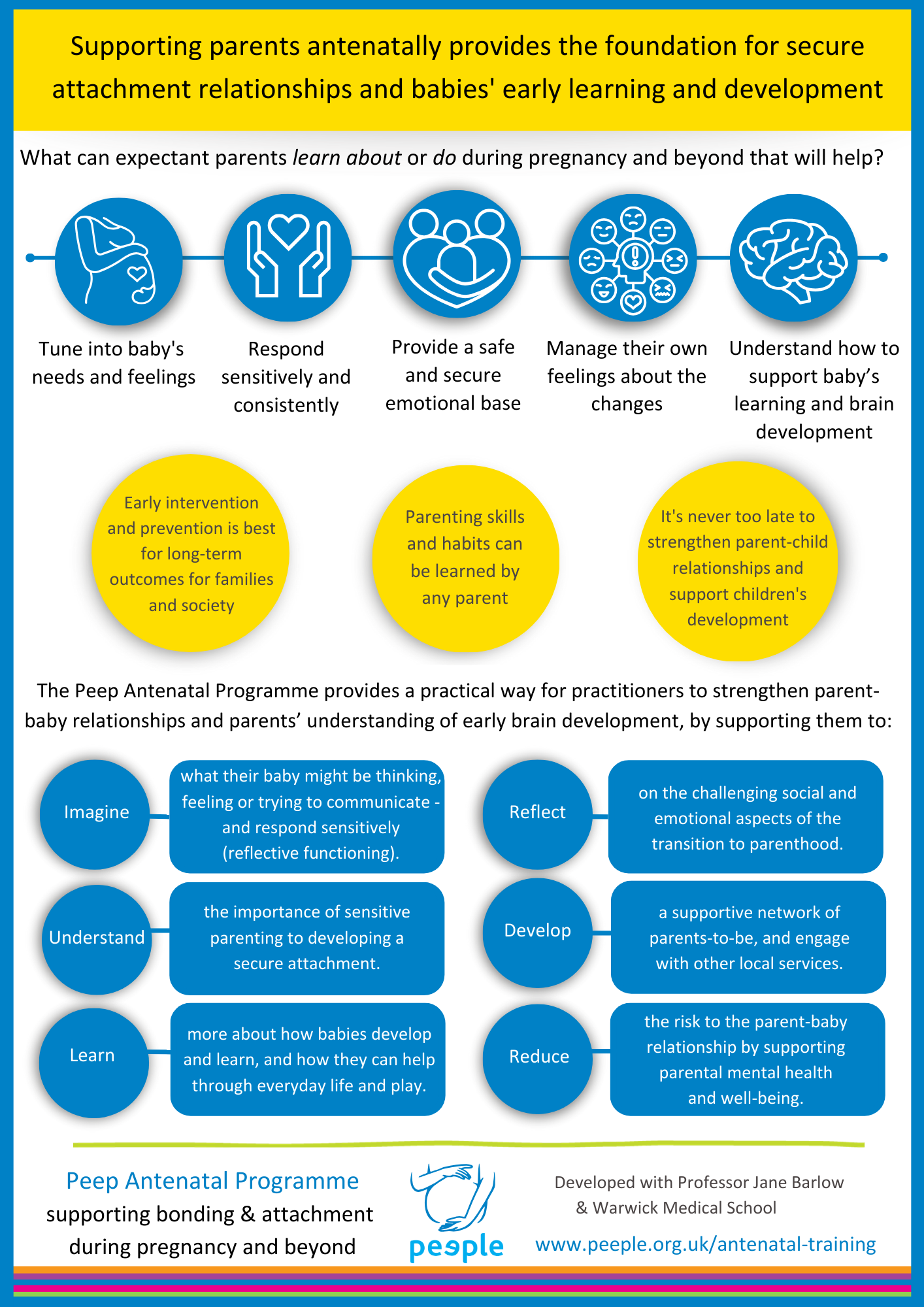
Our antenatal programme supports expectant parents (mums and dads) to:
- think about their baby, tune in to their baby's feelings and respond sensitively (also known as reflective function),
- understand the importance of sensitive parenting to developing a loving, consistent and secure attachment,
- become more aware of the social and emotional aspects of the transition to parenthood,
- manage their own feelings that are aroused by a new baby,
- understand how to support their baby's early learning and brain development,
- meet other expectant or new parents and develop a supportive network group, and engage with other local services,
- reduce the risk to the early parent–infant relationship (by helping to prevent, for example, isolation, anxiety and low-level depression).
These things help parent-baby bonding and attachment. Research indicates that strong relationships enhance parents' confidence and self-esteem. They also contribute to better outcomes for the child in terms of their cognitive development (learning and understanding), the relationships they build, and their resilience to cope if life gets tough.
 Peep Antenatal Training - for practitioners
Our 1-day Peep Antenatal training equips practitioners with the knowledge, practical skills and resources to deliver the Peep Antenatal Programme. As the Covid pandemic has highlighted, early intervention plays a crucial role in supporting families at such a life-changing time.
Feedback from parents-to-be
'I found out lots about what baby gets up to inside my belly'
'We learned how to help our baby to learn and what to expect, and how important it is to interact with baby before she’s even here'
'I enjoyed making baby’s first book, meeting other mums to be, sharing stories’
'Since coming to Peep Antenatal I massage my tummy, sing songs and talk to her'
'I was surprised and pleased to find out that my baby is a lot brighter than I thought'
Using the antenatal programme with expectant parents
The Peep Antenatal Programme can be used perinatally - during pregnancy (from 28+ weeks is recommended) to the early weeks following birth. It can be used for a flexible number of sessions, including one-to-one with parent/s and baby in the home or in other settings, or in groups.
Programme development
Our antenatal programme for families, and the training for practitioners, were developed with Professor Jane Barlow and colleagues at the University of Warwick Medical School. It was originally known as Peep Reflective Parenting. All Peep Programme delivery is underpinned by our principles.
> Download our Peep Antenatal Programme & Training leaflet
> Find out about our Peep Antenatal Training for practitioners or check out the next Peep Antenatal Training dates.
Feature box body:
Peep Antenatal Programme & Training
'Getting to know your baby'
Feature box colour:
Side Quote:
-
‘I didn’t realise my baby would be able to hear when he was born…’ (Dad)
-
‘I’d never thought it was worth talking to a new born baby’ (Mum)
find out more or book training
tel 01865 397 970
[email protected]
> antenatal training
> in-house training
> training courses
> sign up to our e-newsletter
Side Image:
Side Image 2:
Side Quote Color:
- Read more about Peep Antenatal Programme: Getting to know your baby
- Log in or register to post comments
Testimonial placeholder
Feature box title:
PlaceholderFeature box body:
aljsojsklmn fsojfosndl
Stay in touch
Feature box title:
stay in touchFeature box body:
musical partnerships in play (MERYC)
Body:
Reflections from Alison Street on the 2014 MERYC-UK conference in Cambridge
MERYC stands for Music Education and Research with Young Children - a network of musicians, teachers and practitioners interested in the interface between practice and research in the musical lives of young children and their families. The themes of the conference, Music, Partnership and Play were explored through two keynote presentations by Dr Sue Rogers (see her chapter in Pretend Play and its role in Young Children’s Thinking) and Professor David Hargreaves (who wrote The Developmental Psychology of Music). Current issues and practice were discussed through eleven practice papers, ranging from music with neonatal at-risk babies, to music in the everyday lives of young children, to music in the EYFS.
The research papers presented included the playful musicality of two year olds, our PEEP action research with South Asian families, exciting work on music and children’s self-regulation and research on the purpose and influence of music in children’s centres. The workshops took us through practical activities, conversation, reflection, dance, stories and laughter. Titles like 'Every song tells a story’ and ‘Let’s move, let’s ride, let’s sing, let’s laugh’ explored how playfulness can be inspired by musical forms, while laying a foundation for listening, language, movement, social and spatial awareness and expression.
Nuzhat and I presented a paper on the Action Research projects involving PEEP with South Asian families in Oxford. Nuzhat continues to work with women with pre-school children – women who have felt isolated for any number of reasons. Some feel lonely and far away from family support especially if they are newly arrived; some are depressed because they feel under pressure of household duties and family expectations; some are ashamed of their home language because (for colonial and historical reasons) Punjabi does not receive the same status as English and Urdu. With conference delegates we explored ways of breaking down this sense of isolation through collectively re-constructing memories of songs and stories from our childhoods. The warmth and accessibility of Nuzhat’s singing voice bring these back to life in the PEEP CD Singing Together in Urdu and Punjabi which contains songs remembered by Oxford parents.
We can see how powerful singing can be in recreating childhood memories, how talking about songs and stories can articulate the values dear to individuals’ family lives, women’s own self-awareness and their aspirations for their children in the UK.
In this presentation of Nuzhat’s work through PEEP we could witness how music is meaningful to families in playful games and songs, and how it is used in partnership between practitioner and families. It also provides a medium in which the ORIM framework can be explored with parents:
- Opportunities to sing and talk about childhood memories and stories
- Recognition of music’s expressive role in enhancing and supporting children’s home language
- Interaction through playing and singing together
- Modelling the gestures and words of songs both old and new.
MERYC-UK is part of a wider European network which will hold its biennial conference in Estonia in May 2015 (see www.meryc.eu).
Brief reflections about another research presentation on the value of action songs.
how action songs help
Reflections from Julia Shay on the 2014 MERYC-UK conference in Cambridge
Another session particularly relevant to Peep practitioners focused on observational studies in a Children’s Centre, undertaken by Jessica Pitt as part of her doctoral research.
Jessica had compared what went on in outdoor play, art activities and parent-child music sessions. She was trying to understand what is actually going on at a deep level when parents and children engage in action songs and rhymes in a group setting. Her conclusion was that during the practitioner-led music sessions everyone is doing the same thing at the same time, and that with action songs everyone can join in at least a bit. She referred to many interesting concepts such as the role of music in ritual and culture, Turner’s writing about rites of passage, stepping over a boundary and becoming someone else in the group, and also the idea of experiencing group flow.
Jessica also talked about the role of smiling and laughter as social release. So a music session in a Children’s Centre can provide a useful emotional and social function for adults and children as well as developing children’s knowledge of language. Something that on the surface might appear to be a simple enjoyable interlude can be an extremely powerful opportunity for learning, growth and integration.
Feature box colour:
Side Quote Color:
sharing research
Body:
An important part of Peep's role is to promote research about supporting families with their children’s learning. There is a dynamic relationship between research into Peep programmes, and their development and delivery by practitioners and families around the UK and beyond. Research findings can offer fresh insights for practitioners, while new and evolving ways of delivering the Peep programme continue to be evaluated.
In many countries, government and society are increasingly recognising the importance of parents’ and carers’ roles in children’s learning. There has been an increase, over the past couple of decades, in research in this area.
The following pages contain a few examples of research that might be of particular interest to those involved with Peep programmes.
Feature box colour:
Side Quote Color:
room to play
Body:
Room to Play was an innovative drop-in style provision in a community shopping centre, underpinned by the Peep ethos and programme. It aimed both to welcome and value all parents and carers, and to extend their existing parenting practices. Room to Play sought to appeal to ‘excluded’ or isolated families who, for a range of reasons, may not have accessed other services. The project was funded by the Sutton Trust and the Garfield Weston Foundation.
Several recent research studies point out that it is often the services themselves that inadvertently exclude families. As Oxford University’s evaluation (Evangelou, Smith, Coxon, Sylva, 2008) indicates, Room to Play has gone a long way towards overcoming these barriers and engaging with a wide cross section of families.
engaging families: approaches used in room to play
- Taking the service to the user, rather than expecting the user to come to the provider: Room to Play was based in a busy community shopping centre, and was open six days a week throughout the year.
- Effective engagement requires time, sensitivity and flexibility: relationship-building, friendship and social interaction were some of the successful ways of supporting parents and children. Staff also helped parents to ‘move on’ and access other provision.
- It is important to locate the service in attractive premises: parents said that they felt comfortable within the open-plan, home-from-home environment. They could relax with their child(ren), as well as joining in ‘messy play’ activities (such as painting, and playing with playdough, water, sand and ‘gloop’).
An independent evaluation of the project was carried out by the University of Oxford, in three phases. Download a brief summary or the final full research report of the evaluation here.
Peep-trained practitioners from any professional background can use the Learning Together programme with families in any context or setting. Follow the links for more information about our Learning Together Programme and Training.
Feature box body:
room to play (shopping centre) study
Feature box colour:
Side Quote:
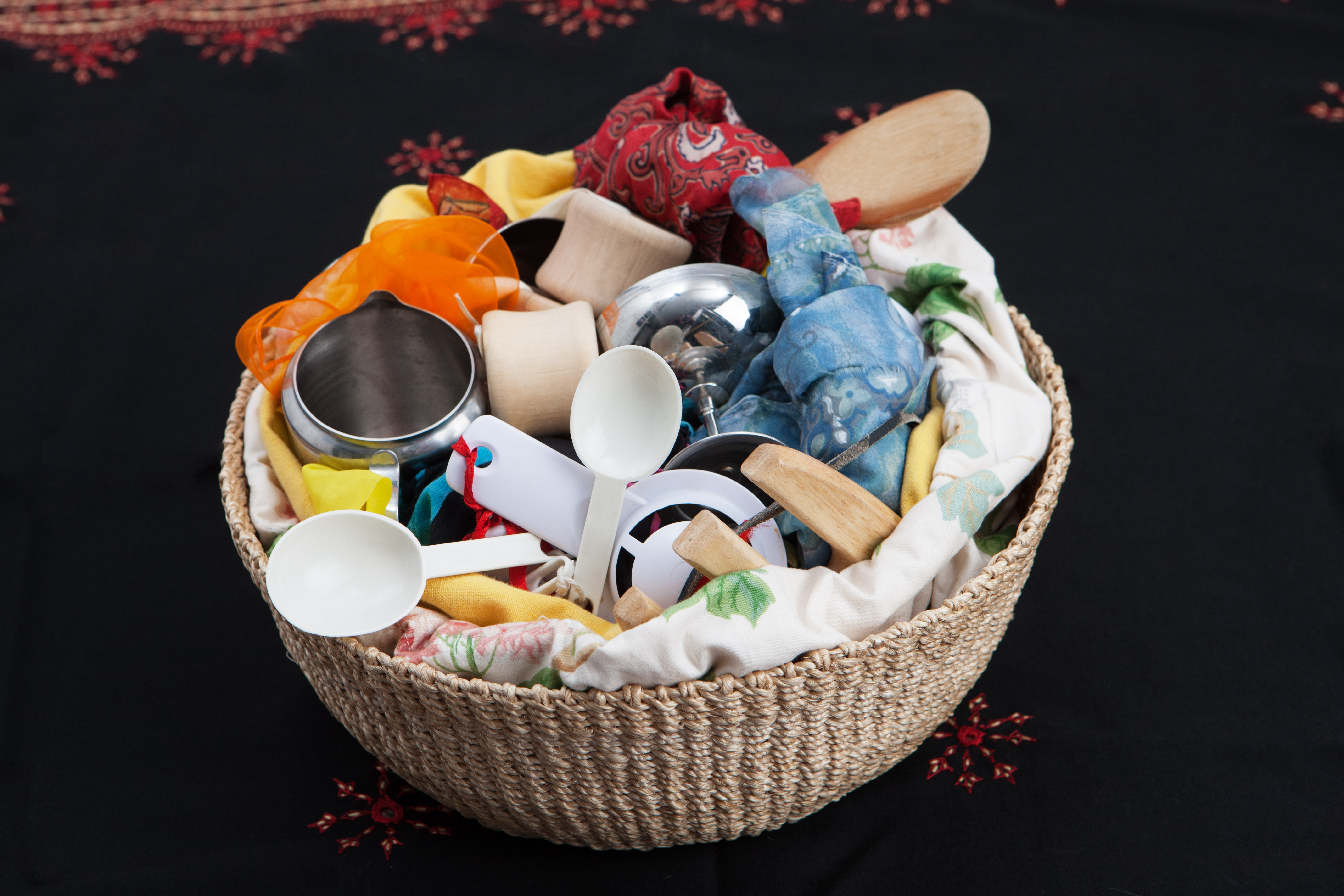
‘Room to Play had decreased [the mum’s] social isolation, and importantly, she had begun to interact more positively with her child, and was growing in confidence. She had made a treasure basket for her child and was beginning to use everyday objects such as wooden spoons in playing with her son.’
Side Image:
Side Quote Color:
peep antenatal programme study
Body:
A small scale evaluation of the Peep Antenatal Programme (n=10) was carried out at the University of Warwick. The Programme (originally known as Peep Reflective Parenting Programme) aims to support strong parent-baby bonding and attachment relationships, helping develop parents' reflective function and confidence in tuning in to their baby’s feelings and behaviour.
The study followed 10 parents who received the intervention programme (in additional to their normal antenatal and postnatal care). Data was collected before the programme began, at the midpoint of the programme and shortly after the programme finished. The primary measures used were the Parent Development Interview, Parent Embodied Mentalising and the Crittenden Care Index.
key findings
- Parents are less intrusive and more inclined to think about, and articulate, their baby’s thoughts and feelings, which is a key indicator of reflective functioning capacity.
- Improvements have been noted in parental behaviours associated with sensitive parenting.
- A reduction has been noted in parental behaviours identified as controlling and unresponsive.
- Parents who were in the clinical categories of risk or ineptness regarding their relationship with their baby, have moved to adequate and sensitive categories.
- Parents described the Programme as enjoyable, informative and non-stigmatising.
- Parents requested additional practical examples of activities, rhymes and techniques that they could practice with their ‘bumps’ and newborns in order to maximise the development of a positive attachment bond. They also asked for further information about infant development, including neurobiology and attachment.
A research summary of the findings can be downloaded here.
Follow the links for more information about our Peep Antenatatal Programme and Peep Antenatal Programme Training.
Feature box body:
peep antenatal programme study
Feature box colour:
Side Quote:
‘An early secure attachment relationship with one or both parents is known to be highly protective of babies’ psychological and emotional wellbeing and mental health.’ (Slade, 2005)
Side Image:
Side Quote Color:
peep evidence base
Body:
Our work has been evaluated in a number of independent research studies by the Universities of Oxford, Queen's Belfast and Warwick. These show that Peep:
- helps children develop strong foundations for language, literacy, and self-esteem - improving outcomes for all, but with the greatest impact for the most disadvantaged,
- successfully reaches families and engages them in their children’s learning,
- helps parents become more aware of their children’s development and how to foster it,
- contributes to parents’ and children’s confidence in themselves as learners, and to parents’ employability,
- enables practitioners from a wide range of professions to develop new skills and fresh approaches to share ideas and unlock parents’ potential.
A Randomised Controlled Trial (RCT) study of the Learning Together Programme was carried out by Queen's University Belfast, funded by the Education Endowment Foundation (EEF). The report was published in 2020; you can watch a short video or read an overview of what the study involves, and how it helps narrow the gap in educational attainment:
- Learning Together Study
- 90-second video: Narrowing the attainment gap with the Peep LTP – findings from a Randomised Controlled Trial (RCT)
Four formal research studies on the Peep Learning Together programme have been carried out by the University of Oxford:
Five of the families who were part of the Birth to School Study took part in a small Tracer study twelve years after they attended Peep, involving a semi-structured interview.
The University of Warwick has carried out the following research studies:
- Early Explorers: Integrating partner professionals to support parents with their children’s development from birth in child health clinics
- Reflective Parenting - Peep Antenatal Programme. This is a pilot report with interim findings.
Case studies from organisations using Peep programmes, around the UK and beyond, demonstrate some of the outcomes from using Peep in a wide variety of contexts and settings.
- This includes a report by the Learning and Work Institute into 'Increasing the employability of parents/carers', which includes a focus on family learning in Derby Peep.
Feature box title:
find out more about the peep evidence baseFeature box colour:
Side Quote Color:
healthy peep in Midlothian
Body:
Reflections from Jan, a Peep practitioner, on a 9-week Healthy Peep course in Midlothian, with pre-school age children.
‘The topics were chosen by parents/carers, in an informal chat as to which they felt were most important. They included healthy eating, hygiene, exercise, co-ordination and friendships. Health-related activities, like child massage (with a visiting specialist) and cooking were added, and the songs and stories linked to the topic.
We provided play packs that families could borrow, including drawing and threading activities for motor development, healthy eating games, and story books, some of which dealt with sensitive issues, such as death and divorce.
Each week we told parents and carers what next week’s topic would be, so that they had the opportunity to bring along any questions or input for talk time.
Evaluation - main themes:
- Parents reported their children to have an increased awareness of the connection between food/exercise and being healthy. Parents were now more aware of giving their children choices, and that their children were consciously making healthy choices.
- Families really valued the time to socialise with other families, and the social support provided by Peep.
- Parents also valued the opportunity to discuss topics with other parents, and share knowledge and experiences. Seeking support from other parents is a strong factor in parents being able to make positive changes.
- All families who came along to healthy Peep stayed for the entire duration, with dads/grandparents coming in place of mothers if they couldn’t make a week. As one dad said, ‘It’s not something that I would usually do but there was no way we could miss a week, we’re all learning so much.’
- Parents appreciated the quality one-to-one time with their child.
- Most parents/carers reported that the songs and stories were an activity that their children really enjoyed. Singing was the most common activity that parents reported now doing at home.’
Feature box colour:
Side Quote Color:
water peep in Newcastle
Body:
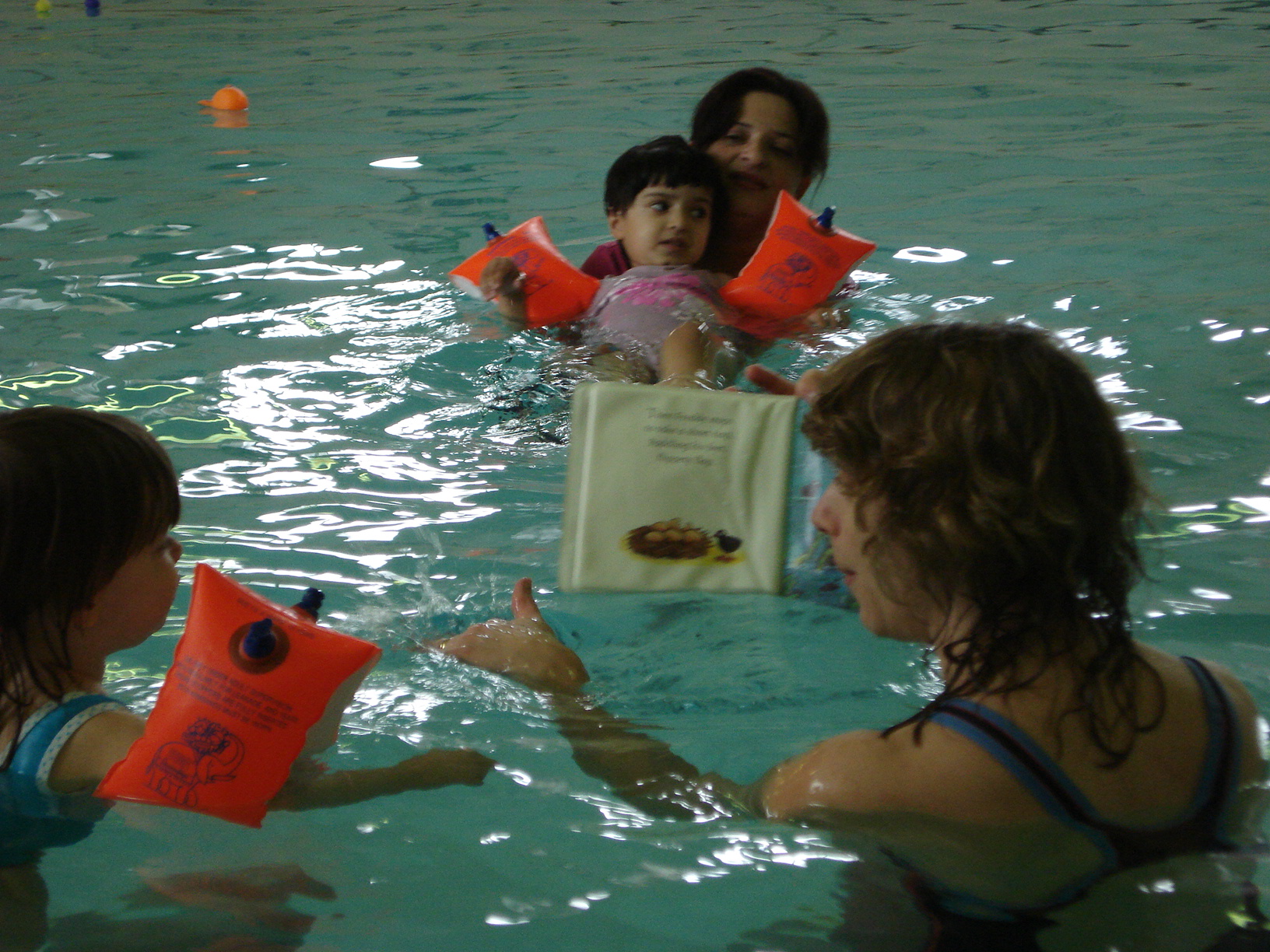 Practitioners around the country have delivered their own versions of Water Peep. In Oxford, practitioners developed a 7-session Water Peep course focusing on movement and communication. Several children with physical disabilities attended, as well as parents who, in their own words, ‘don’t do groups’.
Here are some reflections from Alison in Newcastle-upon-Tyne, who set up a Water Peep group a few years ago:
“We simply transferred the elements of a Peep session into the pool, with babies from about four months up to school age. So, we sing the hello song, use songs and rhymes, use bath books and water toys. There are loads of ideas for activities in the water once you start to look around and think about it, and we found lovely flannel finger puppets, massage balls, child mirrors, etc. We also take along a spare towel and swim nappies. Some Muslim mums have attended and worn t-shirts and leggings in the pool.
We co-deliver our sessions with a Water Confidence instructor, who continues to build in other elements. We manage the talk time over refreshments in the coffee bar after the families are all dried and dressed. Interesting spin-offs for us have been that the session has attracted more dads than we would normally get to our Peep groups, and all the children recently got a ‘duckling’ badge.”