
supporting parents and
children to learn together


Blue
Peep TALK Training
Body:
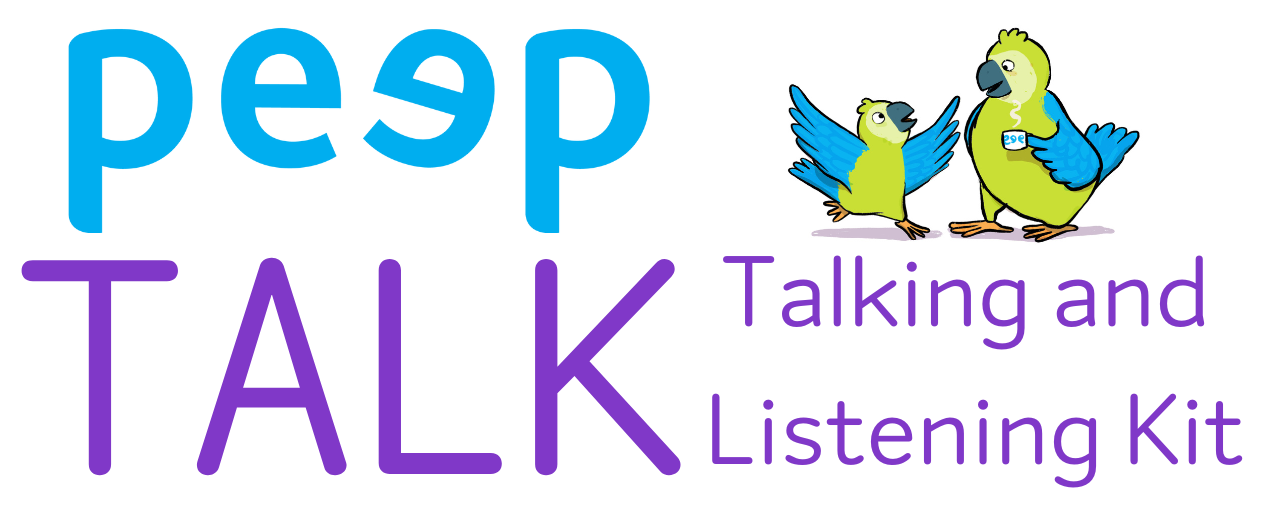
Peep TALK is a Talking and Listening Kit full of practical strategies and ideas for practitioners to share with families.
Aims – the Peep TALK Programme Training equips practitioners to:
- expand your knowledge, skills and understanding in supporting parents with their young child’s speech, language and communication development, including those who are concerned about delayed language development
- use the Peep TALK programme as a flexible toolkit, offering parents strategies and activities to boost their children’s language and communication during everyday interactions in the home learning environment
- deliver Peep TALK sessions with parents and children together, in one-to-one or group sessions
> Book a place or course: Check course dates for open courses and complete the Booking Form for Peep TALK Training or arrange your own in-house training course

During the training: You will explore practical delivery ideas, strategies and resources, using the Peep TALK Programme. The training values and builds on your knowledge, skills and experience.
Online access to TALK programme resources: The training includes on-going access to the Peep TALK programme, full of practical ideas and activities. It contains eight group or 1:1 sessions, along with ‘Talking at Home’ handouts, tips and video clips for you to share with parents and their children. If you've already completed Peep TALK Training and created a website account you can log in here to access your Peep TALK resources.

Who should attend Peep TALK training:
Peep TALK is for any practitioners working with parents of young children, particularly parents who are concerned about their child’s developing speech, language and communication. This could, for example, include staff in family hubs or centres, children's centres, community centres, or education and childcare settings.
Peep TALK aligns with our other Peep Programmes and Training, focusing on the why, what and how of supporting parents with their children’s development in a fun and flexible way.
Why Peep TALK Training is needed:
Speech, language and communication is the most common type of additional support need identified by primary schools. Early intervention is crucial in supporting children's communication (and preventing problems) in the earliest years, as well as identifying language difficulties early on.
The evidence-informed Peep Talking and Listening Kit was developed by Peeple in collaboration with Speech & Language Therapists, building on our joint work with early years settings and families over the past few years. It can be used to support all children with a developmental age of approximately 18 months to four years, including those waiting to see a speech and language therapist.
Peep TALK delegate feedback:
- "Excellent training, plenty of time to look at all the session plans and it was lovely to see them come to life during the demos."
- "The TALK training gave lots of knowledge and also how to share it with parents and carers in a very accessible way."
- "This was a brilliant training, with all the strength of the LTP [Learning Together Programme] but well-focused on Talking and Listening. The session plans are well planned and thought out with a good mixture of activities."
Duration:
- One day: 9.30 - 4.30pm
Training price:
£245 + vat per person, including online access to to all the planning and delivery resources
How to book:
> Check course dates for open courses then complete and return the Booking Form for Peep TALK Training
> Download our Peep TALK Training flyer for practitioners
> Find out about arranging your own in-house training course (online or face-to-face)
> Find out about a free Information briefing for managers
For online courses: We use Microsoft Teams. Delegates should each have a laptop/ computer or tablet to use, at home or at work; if this is a problem please contact us in advance.
Please book and send delegate details at least 10 working days before the course, to ensure that your training delegate pack reaches you in the post in time.
Payment and Cancellation Terms and Conditions: Peep Learning Ltd, the trading arm of Peeple, will invoice you after receiving this booking form. Payment is due within 30 days of invoice date. Fees are only refundable if cancelled more than two weeks before the course.
Peep Learning Ltd Vat Registration no: 768 4173 94.
Contact us with any questions: [email protected] or tel 01865 397970
Feature box colour:
Side Quote:
> Find out why Peep TALK is being used in Barking and Dagenham Family Hubs
Find out more or book training
tel 01865 397 970
[email protected]
> dates & booking
> in-house training
> training courses
> sign up to our e-newsletter
Side Image:
Side Image 2:

Side Quote Color:
Making the most of Nappy Time
Body:
Changing baby's nappy is something we often do on autopilot, we do it so many times a day that we can consider ourselves nappy changing ninjas! Nappy time is also a chance to spend some bite-sized 1:1 bonding time with your little one, especially if you have more than one child.
It's surprising how much learning and play goes on during nappy changes too - even though it might not feel like it as you're trying to do the whole thing one-handed while you're wrestling them back onto the changing mat with the other... When they're in a more chilled out mood, there's lots of time for eye contact, singing a song and encouraging your little one to join in, helping them learn the names of body parts as they kick their legs around or smiling and laughing together. And if the two of you get into the habit of singing at nappy time it might even win out over the grouchy escapee act some of the time!
Image:

Feature box colour:
Side Quote Color:
News: Peeple Family Fun Day
Body:
 CBeebies star Nigel Clarke joined our recent Family Fun Day at the Peeple Centre in Oxford. 400 parents, babies and children enjoyed a day of free activities with local partners including The Story Museum, Ashmolean Museum and Oxfordshire Libraries.
Nigel Clarke, a Peeple Ambassador, delighted children with a story session and chatted with families about the positive impact of everyday play and learning on children’s earliest years. Oxford University BabyLab shared information on early brain development and current research, and Oxfordshire Fire Service invited children to climb on board their fire engine and ask questions.
Families joined in lots of Peep activities including sensory and water play, singing and storytelling, parachute games, playdough and craft activities. Local community-based dance school Messy Jam performed for the crowds, and children enjoyed the free face painting, bouncy castle and snacks, kindly sponsored by MPD Print, Co-op and Asda.
As Peeple CEO Dr Sally Smith commented: ‘We have been embedded in the Leys and Littlemore community for over 25 years, supporting parents to recognise that the little, everyday things that they do with their children has a huge impact on their learning. Today is a thank you to families and a chance to showcase our work, and that of our local partners, to the wider community. It’s been a hugely successful day.’
The Family Fun Day kick starts a summer of free activities that Peeple will be taking part in across the county. Please email us at [email protected] to find out more.
Feature box colour:
Side Quote Color:
Blog: 3 key messages from new Sure Start research for organisations using Peep Programmes
Body:
The recent IFS research on the impact of Sure Start on children's outcomes strongly backs up the core idea behind the work of so many of us in the family support and early years sectors. Early intervention can be cost-effective and make a real, positive difference to narrowing the gap in children's outcomes. Sure Start and later Children’s Centres created a one-stop shop for families, bringing together pre and post-natal health services, parenting support including for children with SEND, early learning and childcare, and parental employment support. Similar goals were echoed in Scotland (e.g. through GIRFEC, Getting it right for every child), the Republic of Ireland (e.g. with local Area Based Childhood (ABC) Programmes), and in Australia (through the Playgroup movement).
How is it relevant to Peep practitioners today?
1. Reaching and engaging the families who might benefit the most
As the IFS research found, the positive impacts of Sure Start were greater for the children who lived near the earlier – and better-funded – Sure Start Local Programmes. ‘Much of this extra budget was spent on parental outreach, focused on reaching out to families who were less likely to use and more likely to benefit from Sure Start.’
Most of us these days don't have that same level of funding, BUT there are things we can do to encourage all families to come along. Over the years we have learned from other research on reaching families and gathered tips and experiences from Peep practitioners.
> You can find a list of these practical ideas on the 'Recruiting families and promoting your Peep sessions' page in the login Delivery Support section of the website. If you’re a manager who doesn’t have a login account, just email us at [email protected] and we can send you a PDF version of the info. It includes successful recruitment strategies recommended by Peep practitioners, and an action plan of ideas.
2. Having a friendly and good quality offer for families - with a focus on strengthening relationships and narrowing the attainment gap
As well as focusing on outreach, the earlier Sure Start Local Programmes ‘had much more community input into what programmes were offered.’ The Peep Learning Together Programme has a wide range of topics that practitioners and families can choose from, with a common underpinning theme of helping to improve relationships and the quality of the home learning environment. All Peep programmes offer a strengths-based approach, starting where families are, and valuing and building on what they already do.
The IFS research found that children who lived within 2.5km of a Sure Start centre for their first five years performed 0.8 grades better in their GCSEs. However, the effects were six times greater for those eligible for free school meals than for those who weren’t, with an average improvement of three GCSE grades (e.g. getting 3 Cs rather than 3 Ds).
A similar trend was found in the Peep Learning Together Study, a randomised controlled trial (RCT), which measured the impact of the Learning Together Programme on three year olds. Overall the Programme made a positive difference of an additional two months’ progress over a five-month period to children’s early literacy development. But children eligible for the Early Years Pupil Premium made three months' additional progress in early literacy development, and an additional four months' progress in core language skills and in communication.
3. Having a joined-up approach for families is effective and provides value for money
Families involved with Sure Start benefitted from a multi-agency approach to working. Peep-trained practitioners have often found that a joined-up approach adds value for families. This could be by co-delivering their Peep sessions with a practitioner from a different discipline or organisation (as we do locally through our Growing Minds project), or involving other professionals as ‘signposters’ when reaching out to families.
It’s now widely accepted (if not always well-funded) that starting as early as possible – the first 1001 days – can make a real difference. Fore-warned is fore-armed! The Peep Antenatal Programme helps expectant parents understand more about how they can strengthen parent-child bonding and attachment relationships, and about early brain development. The approach can be used in any context, including alongside other antenatal provision.
The expansion in Early Learning and Childcare has been accompanied by a wider recognition of the importance of the ‘early learning’ aspect. Early years settings often deliver Peep programmes for families to strengthen relationships between the setting and families, and to bring together home and setting experiences, information and ideas that support young children’s development.
Parental employment support is another important aspect of joined-up, holistic services, helping to alleviate family poverty and increase opportunities for parents. The Peep Progression Pathway enables Peep practitioners to deliver and assess credit-rated units for families, as part of their Peep sessions. This has led to parents getting back into further education, training or work.
The Sure Start research is a timely reminder of the value – financial and otherwise – of early intervention. Earlier Sure Start research revealed that almost a third of the cost was covered by savings made from reduced hospitalisations of children in Sure Start areas. The IFS (Institute for Fiscal Studies – an independent economics research institute) estimated that Sure Start also resulted in an 8% saving in SEND support, and that the improved school outcomes were equivalent to a benefit of £1.09 for every £1 spent. We all have a part to play in holding governments to account in thinking about the longer term benefits for families in their policy-making.
Feature box colour:
Side Quote:
find out more or book training
tel 01865 397 970
[email protected]
> training courses
> dates & booking
> sign up to our e-newsletter
Side Image:
Side Quote Color:
News: update on Peep in Australia – empowering families in every state and territory
Body:
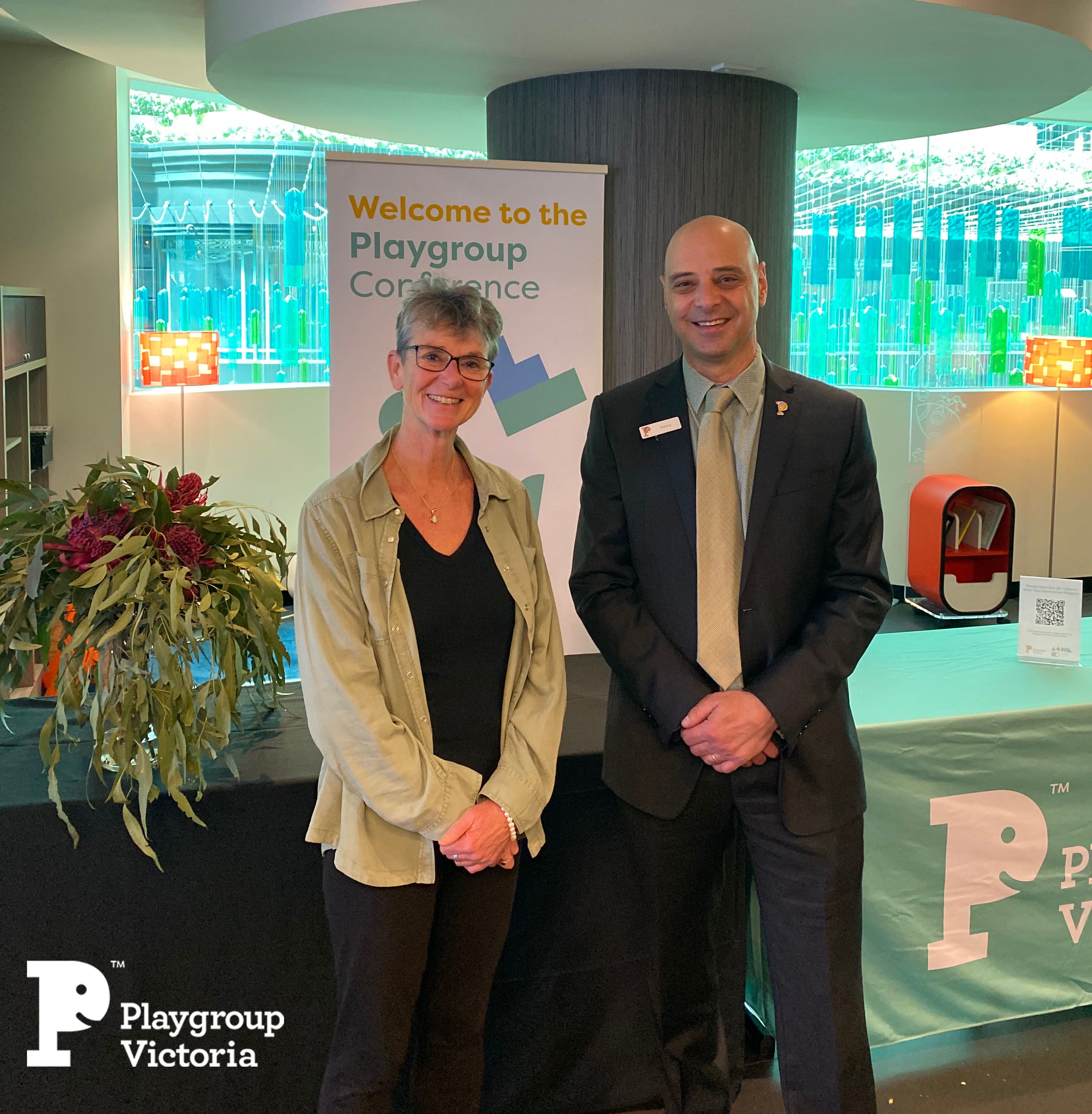 In the autumn, our CEO Dr Sally Smith and our National Training and Accreditation Manager Liz Ersoy visited our Peep partners in Melbourne. Playgroup Victoria hold the exclusive licence for training practitioners to deliver the Peep Learning Together and Peep Antenatal Programmes in Australia.
Claire Georgiou is Playgroup Victoria’s Peep National Manager and has been at the heart of Peep training and support in Australia for the last few years. By continuing to offer training online, establishing communities of practice and fostering valuable partnerships, the Peep programme is now being used in every state and territory across Australia!
This year Claire will be pulling on her travelling boots, thanks to securing government funding to train and support Peep trainers across five states: Victoria, Northern Territory, South Australia, Tasmania and New South Wales. You can find out more about Peep Training in Australia or contact Claire here: www.playgroup.org.au/for-professionals/peep/.
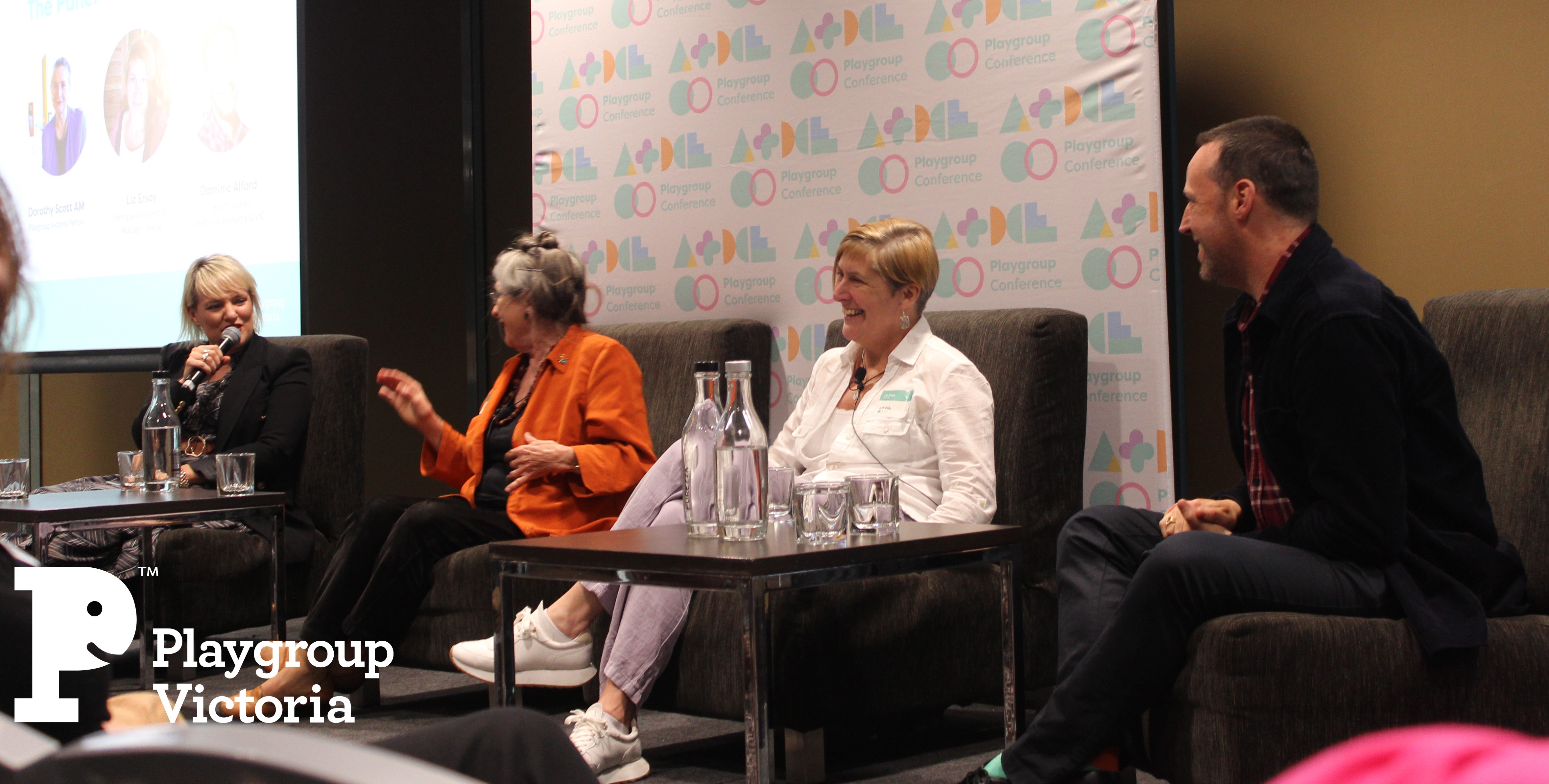
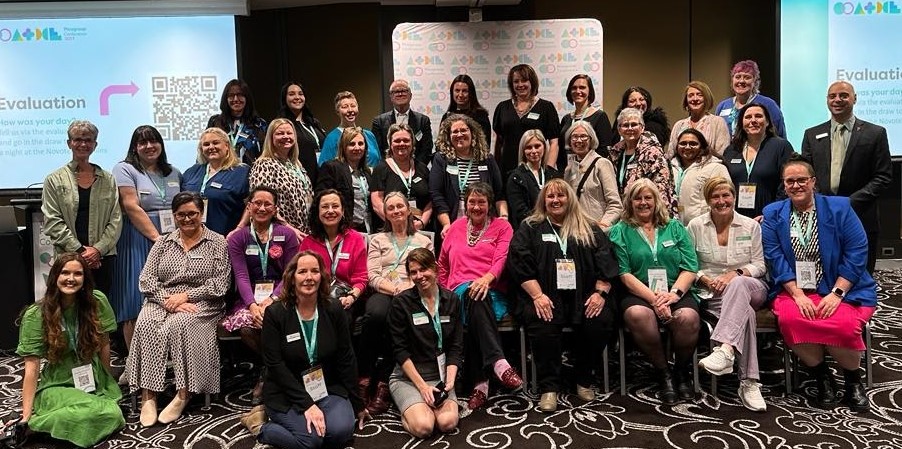
Peep was a focus of the Playgroup Victoria Conference, where 300+ professionals from a wide range of early years settings created a really lively atmosphere.
Sally gave a keynote speech about Peep, Claire led a workshop focusing on Peep and the home learning environment, and Liz participated in a panel discussion focusing on children’s agency in the early years.
The trip also gave Sally, Liz and Claire the opportunity to visit some brilliant Peep groups and have valuable discussions with families, professionals and researchers. These included the Parenting Research Centre, the Australian Catholic University, Thrive by Five, Monash University, the Tomorrow Today Foundation, Milla Milla Aboriginal Playgroup, and many other early years, family support and health organisations.
Images:
Top right: Peeple CEO Sally Smith and Playgroup Victoria CEO Danny Schwarz
Above right (l-r): Panel host ABC broadcaster and writer Jacinta Parsons, Dorothy Scott AM, Playgroup Victoria Patron, Liz Ersoy, Training and Accreditation Manager, Peeple UK, Dominic Alford, Programs Leader, Relationships Australia VIC
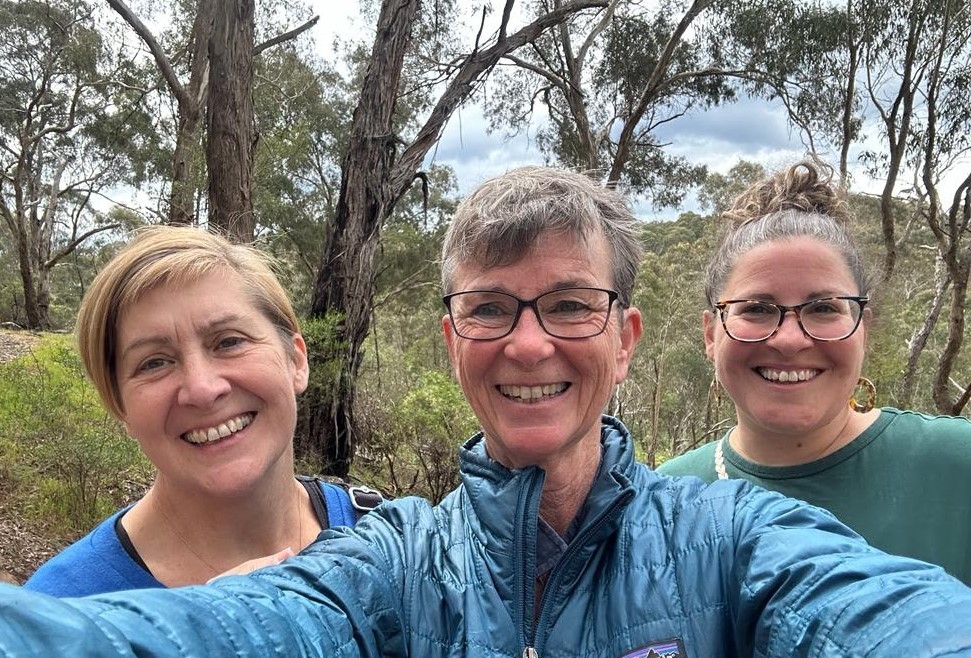
Left: Liz, Sally and Claire Georgiou
Below: Playgroup Victoria staff and board, Sally and Liz
Feature box colour:
Side Quote:
Read more:
> Interview with Peeple CEO Dr Sally Smith
> Peep in Australia
Side Image:
Side Quote Color:
Image 2:
Blog: Growing Minds - lessons learned and getting involved
Body:
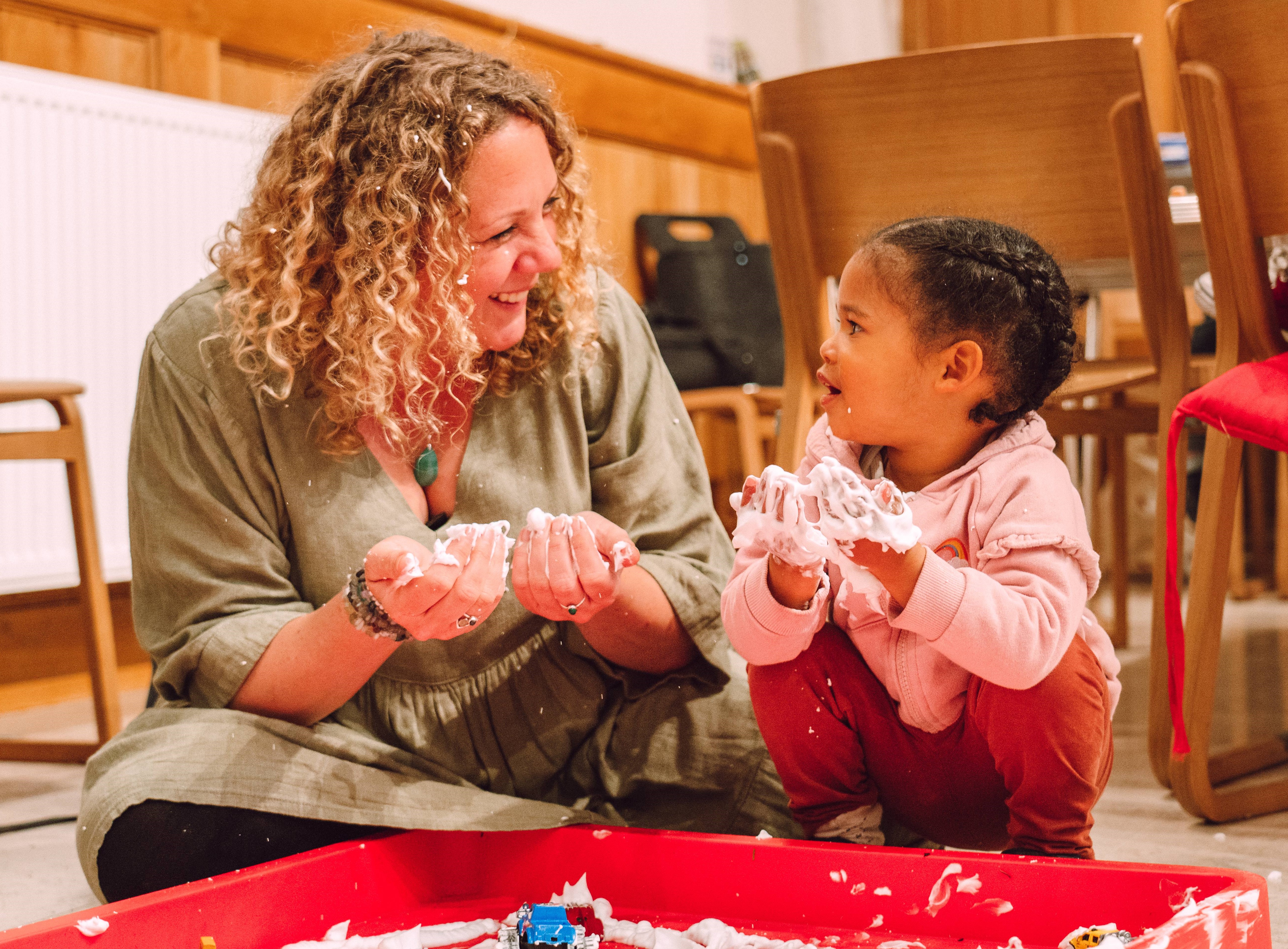
Our third Growing Minds Learning Event in November enabled us to reflect on the last few months - what we did, what changed within our communities, and what we learned - helping us to plan for the year ahead.
Growing Minds is a collaborative, community project that supports and improves young children’s development, school readiness and life chances. We do this by bringing together experienced organisations, local parents and carers, and tried-and-tested interventions. It is led by a partnership of third sector organisations - Peeple, Home-Start Oxford and the Berin Centre – working together in the Littlemore and Berinsfield areas of Oxford and south Oxfordshire.
We really appreciate the positive and thoughtful contributions from everyone who attended, and the generosity of our hosts The Story Museum in Oxford.
Read on – and if you’d like to commission, fund, signpost, find out more, or attend any of our Growing Minds local provision for families - then do get in touch: [email protected].
Here are some of our successes and challenges:
We’re proud of our new 5-minute Growing Minds video, which provides an overview of the project for families and professionals. It captures the voices of partners, practitioners and parents, reflecting on the impact that Growing Minds has had on their lives. Do watch it if you have a few minutes!
Expanding our reach across the communities:
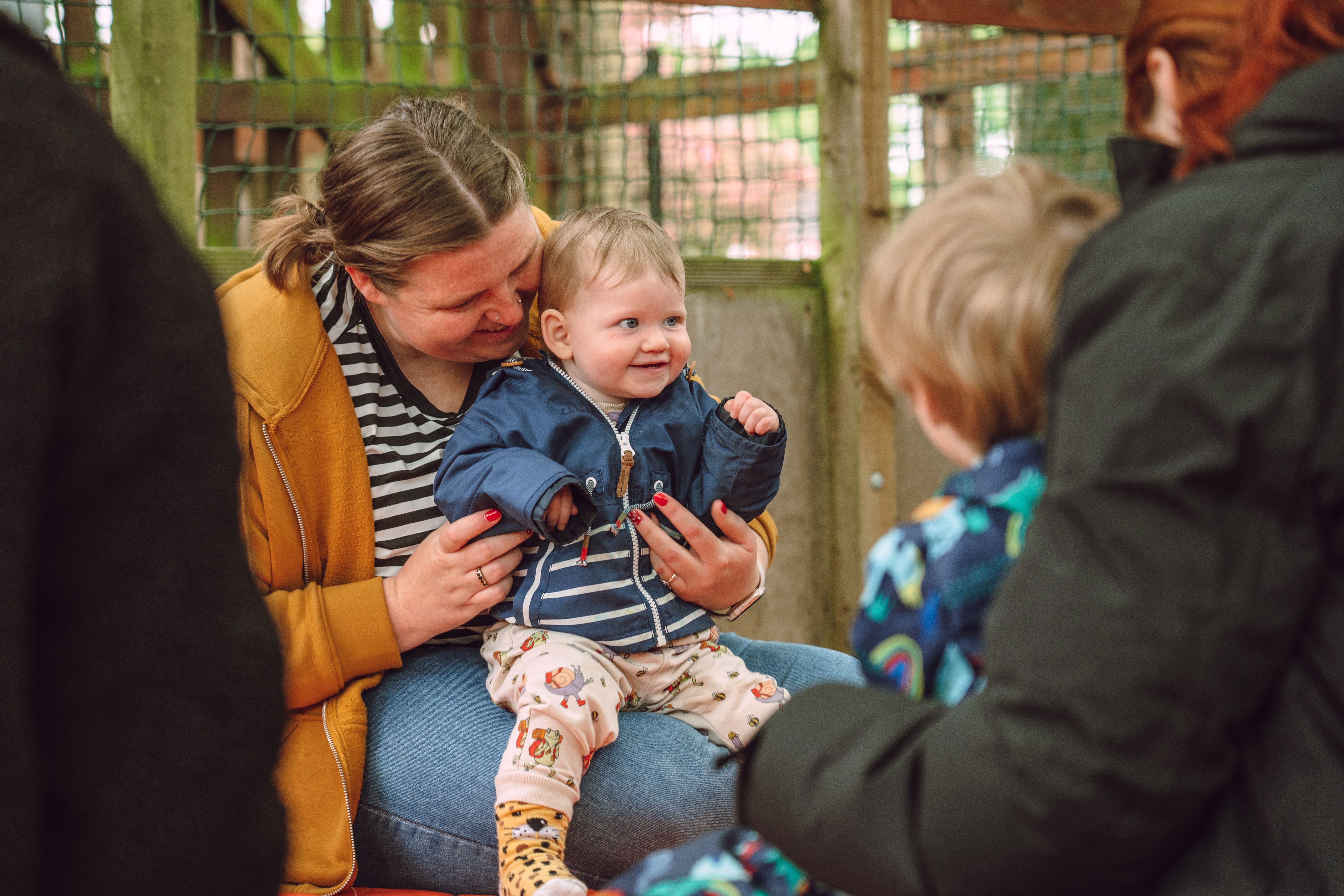 There are now over 500 children registered with Growing Minds. A variety of support is offered, based on families’ interests and needs, ranging from the Dolly Parton Imagination Library books that are posted free of charge to any family wanting to sign up, to Stay and Plays, groups and 1-to-1 sessions for parents and children. Stories shared by Growing Minds parents about their own experiences highlighted the value of this ‘progressive universalism’ approach. For some families, the initial contact about the Imagination Library books provides the first step into accessing other local services. As Sally Smith, Peeple CEO explained, the latest findings from the Learning Together Study show that the Peep Learning Together Programme improves outcomes for all children but has the greatest impact for those living in disadvantaged circumstances.
School and community links:
Katie Screaton, Executive Headteacher of John Henry Newman Academy, enthused us all with her passionate presentation on the impact that Growing Minds is having in Littlemore. Before it began, there was scarce community support for children under five in Littlemore, so it marks a significant transformation. She pointed out that Growing Minds is fostering a sense of community, diminishing isolation, and boosting parental confidence and enjoyment, helping more parents to see and value their role as educators.
Practitioners from the school and Growing Minds deliver a range of sessions with families, often combining topics from the Peep Learning Together Programme with a particular aspect of everyday life, all of which support children’s development and the home learning environment. Following conversations about cost of living issues, for example, the local St Mary and St Nicholas Church donated a number of slow cookers. These were given to families, who also attended a six-week course where parents and children had fun preparing dinner together (cowboy casserole, anyone?) then taking the food home to cook in their slow cooker.
Other groups include Nature Tots, a Special Educational Needs (SEN) parent support group, and Stay and Play sessions focusing on supporting school readiness. For the Growing Minds children who started in Reception this year (aged 4-5), Katie's initial observations were that they have all settled well, and are confident explorers of the Early Years Foundation Stage.
This is the first cohort of Growing Minds children to have started school. It’s exciting and we cannot wait to see the impact that Growing Minds has over the coming years, though we are cautious that this year group will have been most heavily affected by lockdowns and the lack of provision that was available during those periods. We are very fortunate to have such a community-focussed school on our doorstep, and we really appreciate the collaboration that has such a wide impact.
Impact stories from parents:
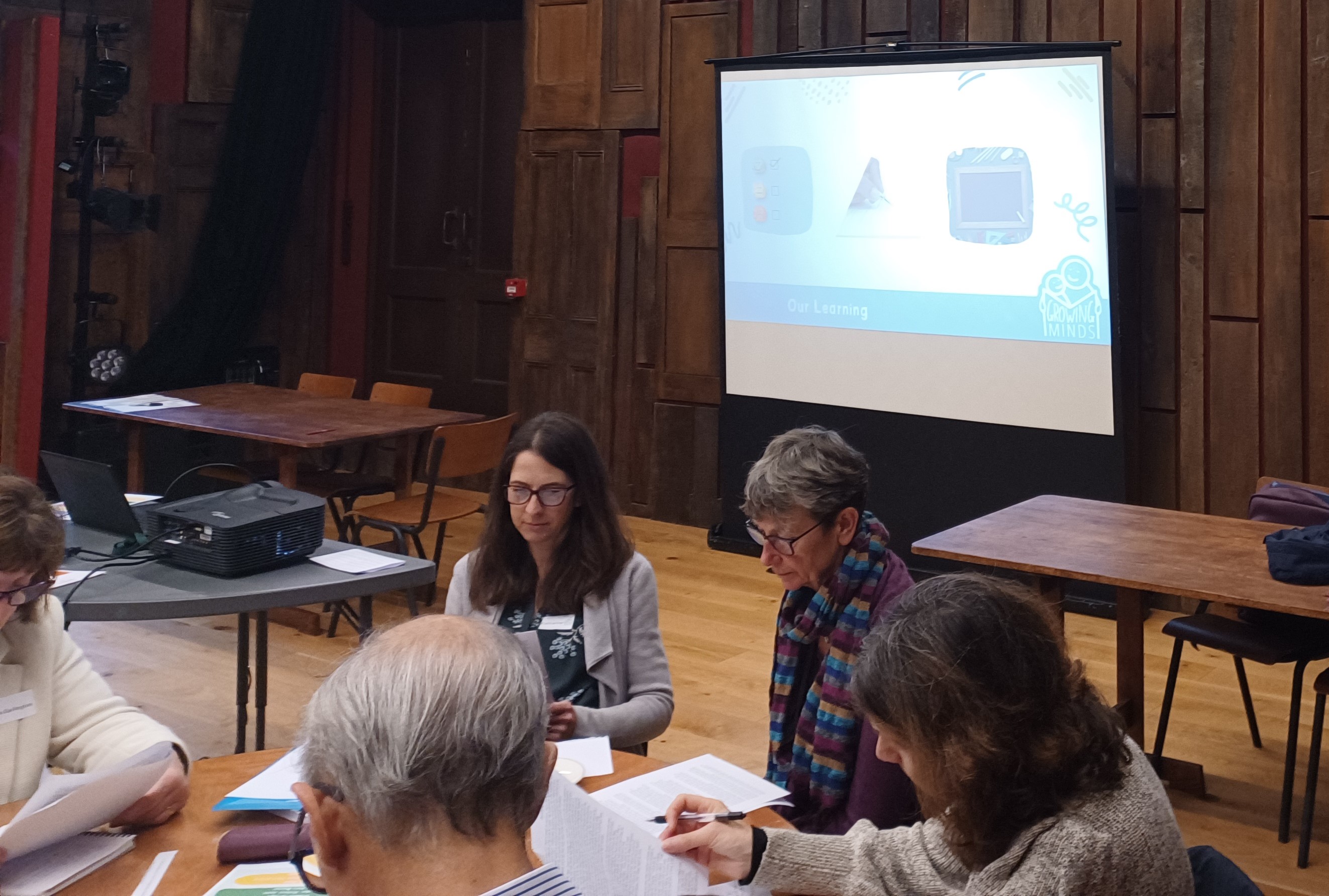
Gathering stories from families about their experiences is an important part of the project. Reading and discussing the stories in groups is always a popular part of the Learning Day. We pulled together common themes, which included the project being as meaningful for parents as it was for children, delivery being done with families not to them, reduced social isolation and easy-to-access support. Statutory services and professionals are stretched to the limit, often accompanied by long waiting lists, and finding an understanding and friendly face was always appreciated by families.
Below you can see a short version of one of the stories.
Local partnership work:
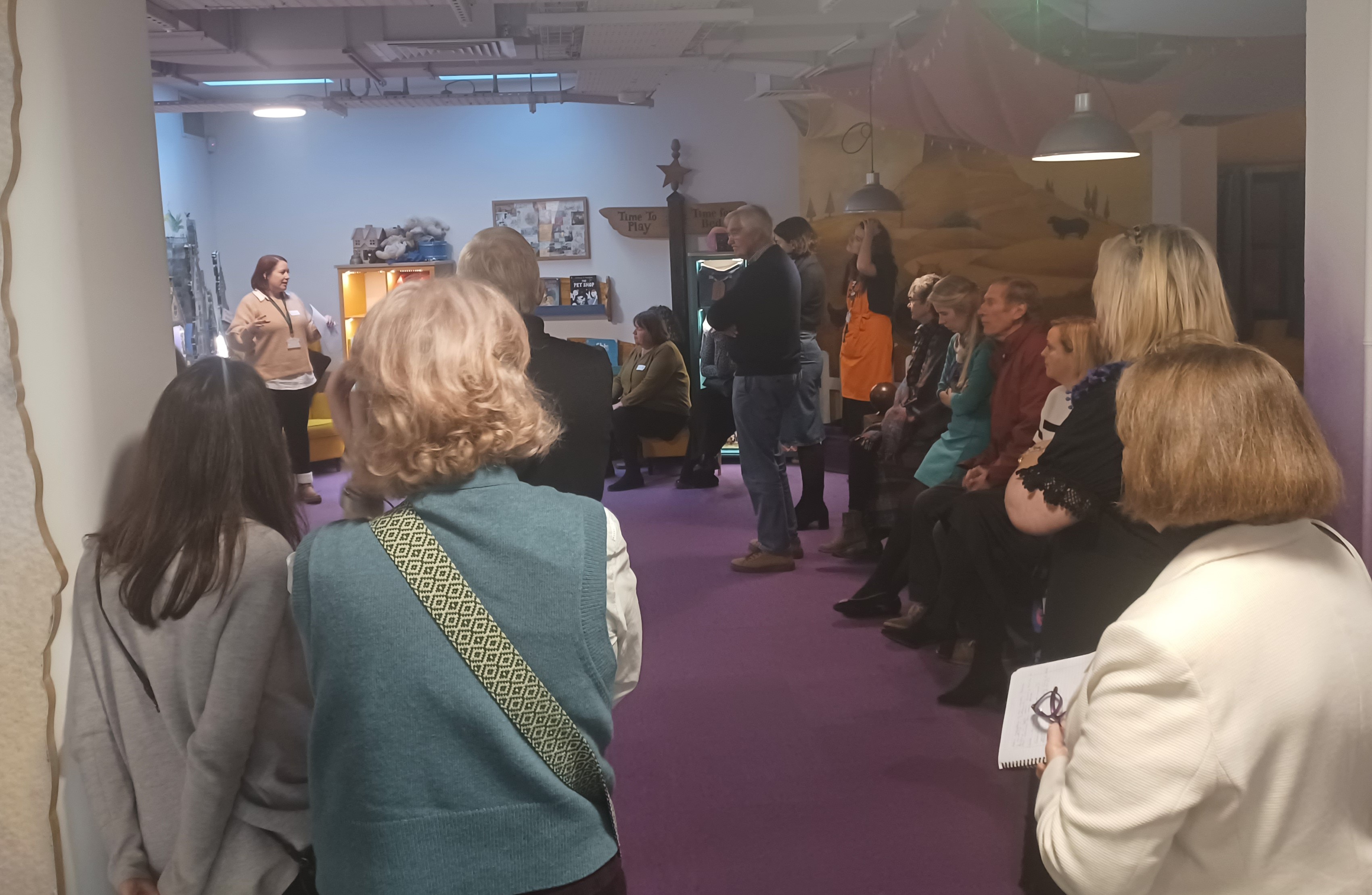 Staff from the The Story Museum took us into their small world area to deliver a section on their community outreach work with Growing Minds. After exploring the room, Victoria Jones, the Museum’s EYFS Co‑ordinator, gave us a captivating demonstration of their storytelling approach and the profound impact that it can have on people of all ages. Story Museum staff inspired families during a dozen Stay and Play sessions in Littlemore – our work shares numerous similarities, and it was a great opportunity to work together. Their sessions culminated in a visit by families to the Story Museum in early November, which went down a treat (and is well worth a visit!).
Lessons learned:
We reflected on what we had learned over the past few months, and our progress on the action plan from our independent evaluation. For example:
- We initially relied heavily on statutory services for recruitment or registrations of families. These referrals from birth registrars are very important as they allow families to hear about the local provision from very early in their child’s life. However, using a more mixed approach through social media, local advertising, schools, nurseries and other community groups means that our registration rate has significantly improved.
- Following feedback from families about the times of our Peep groups, we swapped the toddler group to the morning and babies to the afternoon, and attendance has improved.
- We piloted a community Transition group in the summer for Littlemore families whose children would be starting school outside the local area. This was less well attended than most of our groups, partly for logistical reasons – more than half those invited said they worked during the week. However, we’d also had less interaction with these families when children were younger, due to Covid. This really speaks to the power of the earliest contact with families, building relationships and being able to support them sensitively from when their babies are small. Families were still interested though, with several saying they would have found this type of course useful before starting nursery as well as school. We were still able to offer every family support, and an ideas mat of appropriate activities in preparation for school transition. We will reflect further on our learning in the design of these sessions later in this academic year.
Partnership working and future opportunities:
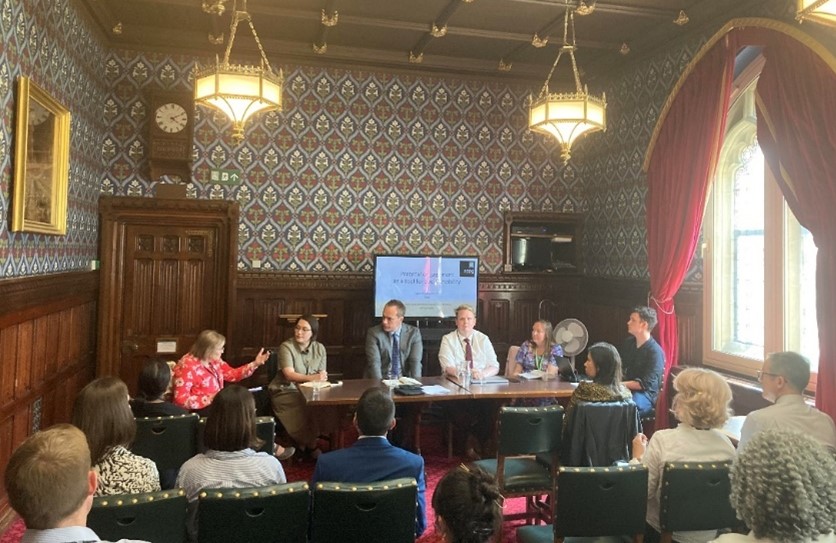 We were invited by the Sutton Trust to speak about Growing Minds at the Social Mobility All Party Parliamentary Group (APPG) at the House of Commons in July. The theme was parental engagement as a tool for social mobility, and it was an honour to share our learning around engaging with parents as early as possible in children’s lives.
- Talking and working with other organisations to learn from each other is an important part of Growing Minds, both locally and further afield. Over the past few months we’ve enjoyed collaborating with organisations such as Oxford Inclusive Economy Partnership (OIEP), Oxford University's Brain Story and Thrive at Five in Stoke-on-Trent.
What next? (how we can help you and you can help us)
We hope you agree that our services are valuable – but they need to be funded. We still need some funding for this financial year (2023/24) and the next. There are (as yet) no government-funded Family Hubs in Oxfordshire.
Do get in touch:
- if you are, or you have any contact with, a local commissioner of family support services or other potential funders (individuals, companies or charitable trusts), who may like to find out more about what we do, or to come along to our next event.
- if you’re a parent, carer or professional who lives or works in Littlemore or Berinsfield, and you want to find out more or come along to one of our sessions, or signpost other local families.
- if you’re part of a like-minded project elsewhere and would like to share ideas.
Becky Young, Growing Minds Manager - email [email protected] or tel 01865 395145
Parent story (short version):
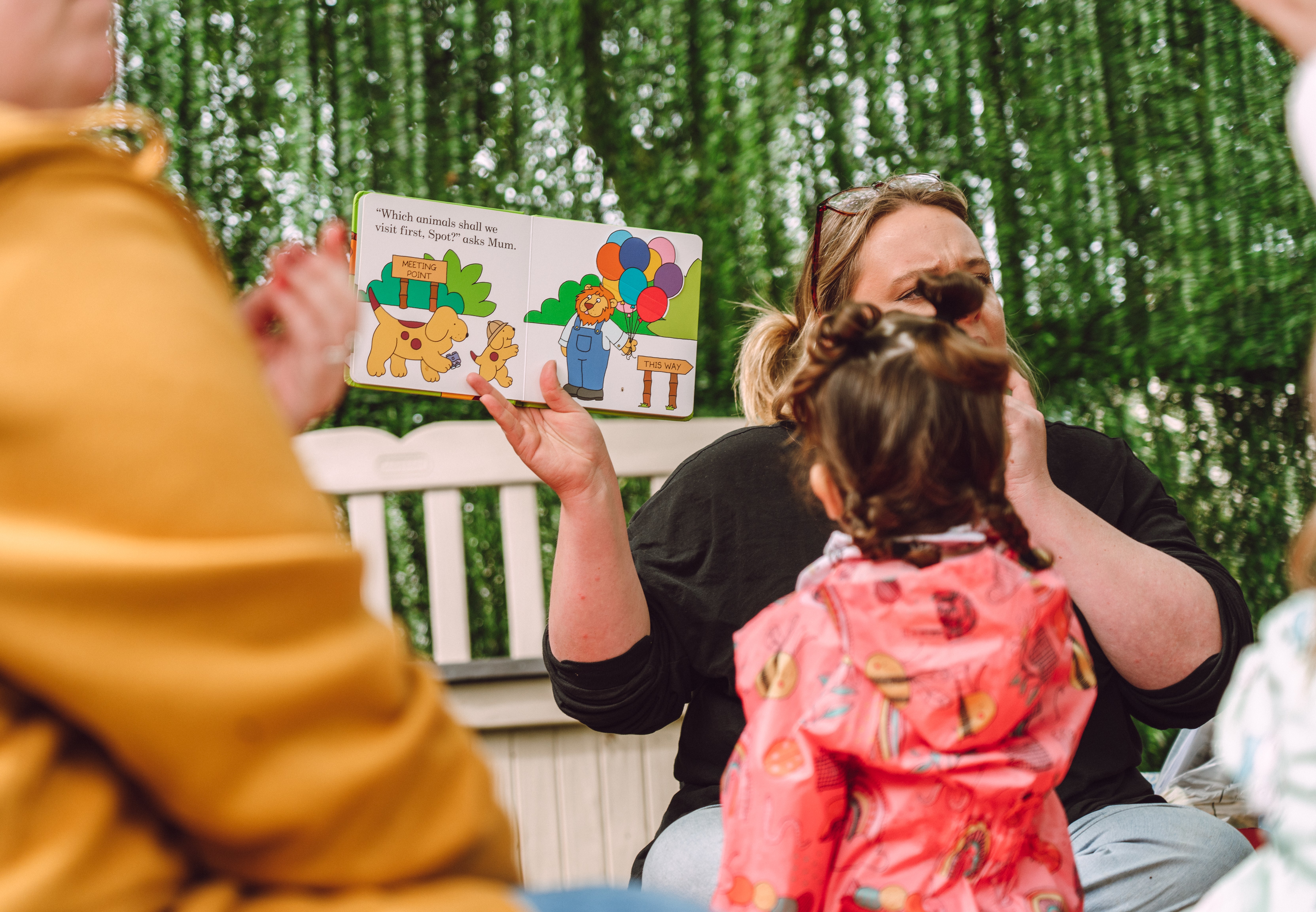 “I was a bit nervous the first time but everyone at Growing Minds and the Berin Centre was really welcoming. The first group I came to was a baby group. Each week is different, you learn so much and it's to improve your knowledge of certain things so you can enhance your child's life for the better. It was important for me to not just sit in the house with my little girl, it gets us out and interacting with people that we normally wouldn't be.
There's quite a lot of us who have similar ages of children, it's really good to see the same people every week, it helps us build the relationships. It's amazing, the other parents and their kids – it was really nice and friendly but if you're having a bad day like you can just tell someone and they'll try and help you. There won’t be any judgement which is really good because my life is chaos.
In the groups, we learn things to do with a child. There was something to do with the brain and I can see the image, that's really stuck with me. I'm quite a visual person so that really helped me. One week we also did about routines. I have difficulty with some of it and it was really reassuring that everyone goes through it which is a relief, and you can talk about it.
I also liked the making marks one that we did which was basically just like messy play. She didn't really get too dirty which was good for me, but she's done it since and she loves it, then I think oh I could do water play at home or I can do this at home - it's just fun.
This is somewhere that you're accepted and listened to. I just think how amazing spaces are like this. I've always wanted a child, I will do anything for her. I just want her to have the best life and coming here definitely helped that and it helps me as well. Parenting is hard, especially when social media says ‘do this’, ‘don't do this’ and it's so conflicting, you just want the best for you and your child. Mum guilt is so difficult but here they encourage you. I feel more connected with the other parents.”
Feature box body:
Blog: Growing Minds - lessons learned about collaborative community support
Feature box colour:
Side Quote:
"I just want her to have the best life and coming here definitely helped that and it helps me as well... Mum guilt is so difficult but here they encourage you. I feel more connected with the other parents.”
Read one parent's story below.
Find out more about getting involved with Growing Minds, as a parent, practitioner, commissioner or funder:
email [email protected] or tel 01865 395145
Side Quote Color:
Blog: What does school readiness look like?
Body:
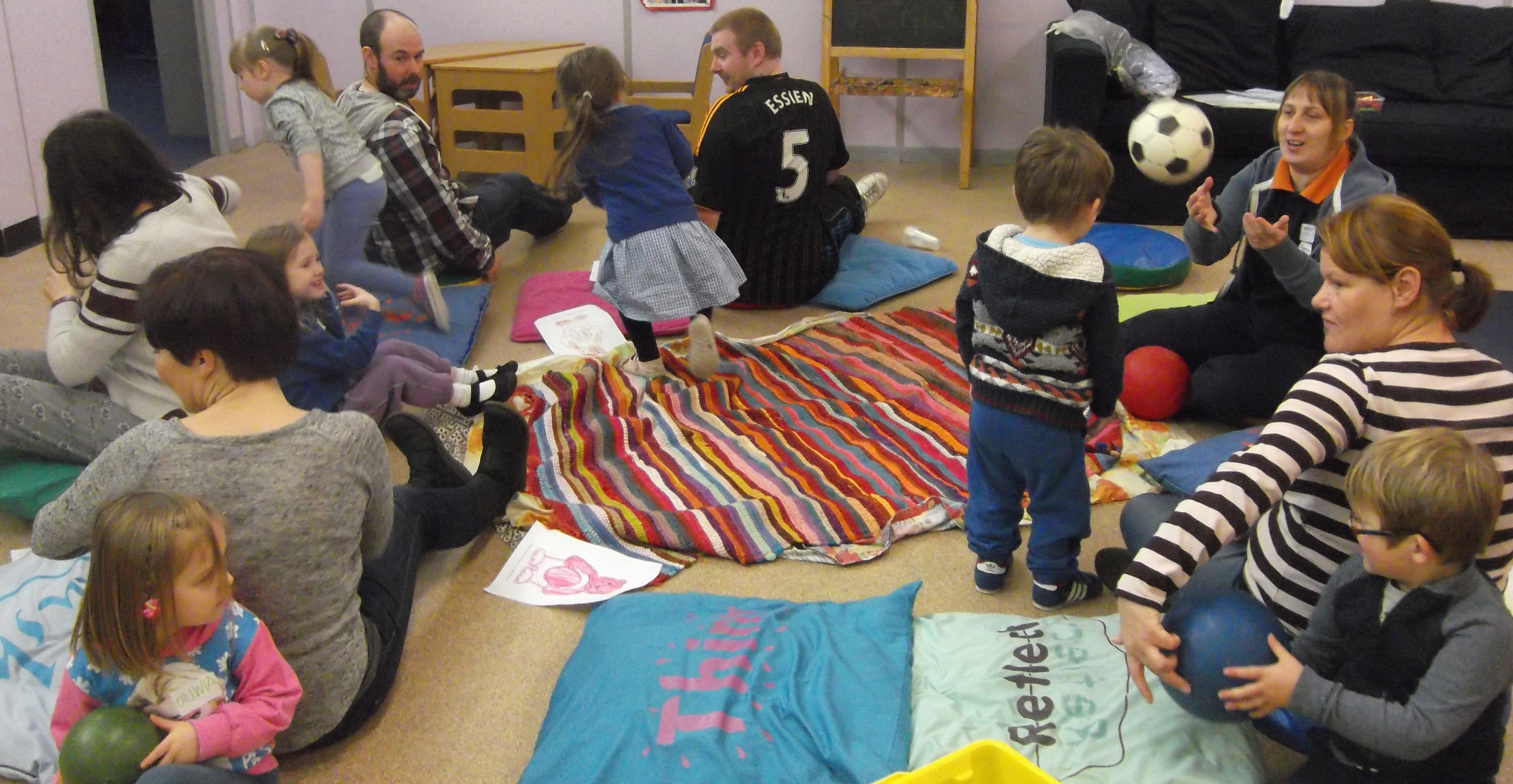 School readiness is always a hot topic at this time of year, but especially now as the early years Covid cohort starts to transition into primary school. Many of these children will have spent a large proportion of their childhood in lockdown, missing out on the opportunity to socialise with their peers and develop key skills. A recent survey conducted by YouGov suggested that half of all children are not ready to start school, and in some settings that has risen to 90%.
But what does being 'school ready' actually mean? A few years ago Ofsted (who inspect schools and children's services in England) released a list of skills that would be helpful for children to have before starting school - and parents may be surprised to learn that phonics, writing and maths are not on the list.
Here are some of the skills that are useful to practise with your child in everyday life:
I can sit still and listen
Schools don't expect children to sit still and listen for the whole day - that's hard even for grown ups - but developing listening skills is essential to communication, play, keeping safe and developing thinking and concentration skills. Model good listening with your child, chat with them and really listen to their responses. In order to become a good listener, children need to know what it feels like to be listened to.
I am aware of other children
Relationships with the people around us are so important and children learn a lot about appropriate behaviour and 'rules' which can help them get on with others. Children learn from everyone! Watch your child next time they play with others and talk to them about how they interact with their friends. Relationships are at the heart of leaning, whether it's in the playground or in the classroom.
I can talk in sentences and I can speak to an adult to ask for help
Talking helps children to develop their thinking and builds confidence - children get better at it when they have somebody who joins in, talks, listens and tries to understand. This confidence will seep into other areas: asking for help, communicating with friends and expanding language.
I am potty trained and can go to the toilet
Everyday activities encourage children to learn how to look after themselves. Routines such as using the toilet, wiping, flushing, pulling pants up and washing hands is a sequence which can be repeated again and again. This in turn grows independence, and will save you - and school staff - a lot of time in the bathroom. If there is a part of the sequence that a child is struggling with, such as remembering to flush, it's worth breaking the routine down and focusing efforts on helping them master that particular part.
I can recognise my own name
Names are a core part of our identity and using children's names in a positive way builds confidence and self esteem. Help children to recognise their own name by celebrating it! Make name placemats for dinner or write it in bubble writing and get them to decorate it - the added bonus is that having fun together with your child's name shows them that they are important.
I can open and enjoy a book
Have you ever had to read your child's favourite book over and over again? This familiarity with language, characters and pictures breeds confidence and encourages children to become 'readers' themselves. Knowing what happens next, joining in with the re-telling (made up or from memory, rather than reading the text themselves) and being able to name familiar things in pictures gives children a real sense of achievement. It's an important building block in learning to read and will spur them on to open, and enjoy, new books as well as old favourites.
I can understand the word 'No' and the borders it sets for behaviour, and I understand the word 'stop' and that such a phrase might be used to prevent danger
Children sometimes struggle to put into words what they are feeling, so their feelings come out in their behaviour. Support and encouragement is important, as is staying safe. Talk to your child about how words such as 'stop' may be used to keep them out of danger - explore songs and stories which will communicate this in a positive way.
I can take off my own coat and I can put on my own shoes
Life skills such as taking off a coat and putting on shoes are often the first big steps towards independence for young children. We do these everyday tasks without thinking but children need us to break it down into chunks for them to be able to grasp them. Time and patience are needed here, and maybe a little bit of fun too. Have you ever seen the coat flip? Look it up, it's genius!
Making these skills a part of daily life will help with the transition into school, and the familiarity of these tasks will underpin confidence at the start of the school journey. If your child isn't at this stage yet, do not worry - teaching and support staff will be there to encourage and help all children.
If you are a Peep practitioner then log into your Members area and search transition or school readiness - you will find Peep resources to support each of the skills listed above.
Feature box body:
Blog: What does school readiness look like?
Feature box colour:
Side Quote Color:
Baby Peep course - suggested topics
Body:
As always - you can choose which and how many LTP topics you include in your Peep sessions, and which order you deliver them in - but here are some ideas to get you started (with link to topic page). We'd recommend adding an introductory session or combining info from the introductory session plan, and possibly the ORIM topic, if your families are new to Peep.
A six-week course for 0 - 12 month old babies:
- PSED: Making the most of routines
- EL: Sharing books with babies
- EM: Maths in songs and rhymes
- CL: Finding a voice
- CL: The very first language
- HPD: Early sensory experiences
A six-week course for 0 - 6 month old babies:
Thanks to Kensington and Chelsea Family Hub, known there as Baby Zone Peep. (Suggested tips or TDAHs in brackets)
- PSED: Knowing me, knowing you
(Baby states photos & Peep Tips/ Taking time to pause… Peep tips) - PSED: The importance of names
(TDAH Making a name card or placemat) - PSED: Making the most of routines
(TDAH Routines and making a bed for a toy) - EL: Sharing books with babies
(TDAH Sharing books with baby, Tip: sharing books, cuddly etc) - CL: The very first language
(TDAH copying games, TDAH making sensory bottle, TDAH Faces in lids; Tips: learn about being loved/ Cuddling and holding…) - PSED Babies making choices: Treasure baskets
(TDAH posting box)
A six-week course for 6 - 12 month old babies:
Thanks to Kensington and Chelsea Family Hub, known there as Baby Zone Plus Peep
- PSED: Becoming me
- CL: Finding a voice
- EL: Sharing books with babies
- HPD: Babies on the move
- HPD: Early sensory experiences
- HPD: Food for life
Feature box colour:
Side Image:
Side Quote Color:
Early Help Peep: Nottingham
Body:
Thanks to Charlotte Haigh, Early Learning Specialist, and colleagues for sharing how they use Peep within their Early Help teams, Family Hubs and Children’s Centres in Nottingham.
 "In Nottingham City, we use the Peep Learning Together Programme (LTP) as a targeted intervention to support families within the city. We have established four Peep groups, each of which runs for 12 weeks:
- Watch Me Grow for families with a child 0-9 months
- Inbetweenies for families with a child 9-18 months
- Getting Ready for Nursery for families with children age 18 months – 2+ years
- Chatter Matters which focuses primarily on communication and language
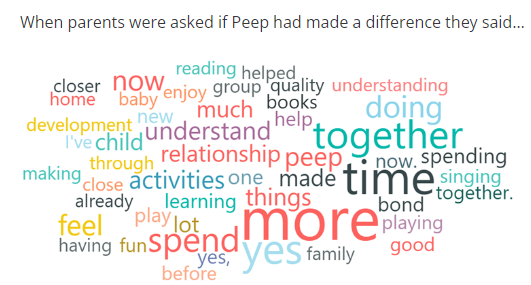
Parents complete an evaluation at the end of the course, but also give verbal feedback about things they’ve noticed or tried that week, at the start of each session. Here are some of the things that we’ve heard from families and practitioners:
Increasing parents’ confidence and awareness about supporting their children’s development:
Through attending one of our Peep Getting Ready for Nursery courses, parents have reported that they feel a lot more confident in telling stories and singing with their children. One Mum shared that she feels a lot more confident singing with her children at home since attending one of our Peep groups, and her partner has noticed that she sings a lot more with her youngest two children than she did with her eldest. This mum still feels too self-conscious to actively take part in singing during the session, but she and her children spend much more time together at home than in a weekly group, so singing with them at home is where the real difference is made.
Our feedback has also shown that parents are a lot more aware of the importance of mark making, and provide mark making activities more frequently within the home.
In our recent courses, 80% of parents showed an improvement in their confidence to support their child’s learning and development. 72% of families have increased the frequency of mark making activities, and of playing with letters and numbers at home. Over the past few months, 61 children have been tracked in either Communication & Language, Physical development or Personal social and emotional development. All 61 children have shown progress in their development over the 12 week course.
Noticing changes and thinking about next steps:
 At the start of the Peep course we encourage parents to complete an ‘I can…’ flower so they increase their awareness of what their child can do, and where they are in terms of their developmental milestones. Once these have been completed practitioners are able to plan activities and sessions to support both parents and children in reaching their milestones. Parents are also encouraged at the beginning of each session to feedback on how they found the previous session and how they got on with their ‘Things to do at home’ activity.
One parent has noticed that, since attending one of our Peep groups, her child has started to say words and to count, and has become increasingly confident in exploring the activities available. At the beginning of the course, this child was non-speaking, wasn’t interacting with other children or adults, and gave very little eye contact. He has started to respond during singing time and sometimes joins in with actions, and he is now also giving eye contact when practitioners interact with him.
Building relationships – families, practitioners and other professionals:
Parents have fed back that their children have built relationships with other children of a similar age. One mum, who shared that she suffers from anxiety, now looks forward to attending the group each week. Practitioners have worked with mum to help her rationalise her thoughts and prioritise tasks to allow her to feel less anxious. In doing so, mum is now more confident to bring her children to the group on her own.
Providing the Peep programme on a weekly basis for 12 weeks has enabled practitioners to build good relationships with both parents and children. Practitioners are able to address behaviours that a few parents in the group are experiencing. For example, in one of our Getting Ready for Nursery groups practitioners noticed there was a lot of copying behaviours and children were throwing toys/ resources. As a result, practitioners modelled to parents how to encourage desirable behaviour and communicate with their children to let them know what they want them to do instead. Practitioners have since commented that they feel the parents within the group have grown in confidence and support each other, as well as asking for help and advice when needed.
During our Watch Me Grow course we look at the topic ‘Food for life’. During this session we invite a health visitor along, to support parents with the latest public health advice on weaning and healthy food choices. Practitioners have found that by partnership working, particularly in the Watch Me Grow groups, parents are less anxious in terms of accessing services and have grown in confidence when it comes to making their own choices for their children.
Things we learned – reducing barriers for families:
- Peek into Peep: In Nottingham we run a ‘Peek into Peep’ session in areas where engagement is low or where we don’t receive many referrals. A Peek into Peep session gives parents the opportunity to meet the practitioners that will be delivering the programme beforehand and see what they can expect from a Peep session. This enables families to feel less anxious when they attend the full course, as they have already met the practitioners and know what to expect when they walk in. We have found this to be extremely beneficial for anxious parents. It also allows for partner agencies e.g. midwives, health visitors, social workers etc, to attend the session with their families to see if it is something they would benefit from.
- Tailor the group to the needs of the families: In Nottingham we have a rough plan of the 12 topics we are going to cover throughout the programme. However, once practitioners have gotten to know the families that attend, they are able to adapt the programme to suit the families. In some of our groups, rather than practitioners planning a child development topic for every week, we let the parents choose what they would like to cover the following week, by giving them opportunities to look at the topics in the Peep Learning Together folder.
- Having a session routine: This supports both parents and children to understand what to expect during the session, and the transition between all elements. We have found that the routine we use does vary between groups and we are happy to adjust and adapt dependent on the needs of the families.
- Having a waiting list and inviting a set number of families per course: this enables practitioners to really get to know the parents and children they are delivering to. This has allowed us to incorporate additional services into the course to support parents, depending on their needs, or to signpost them on to other local services.
Feature box colour:
Side Quote:
find out more or book training
tel 01865 397 970
[email protected]
> information briefing
> in-house training
> training courses
> sign up to our e-newsletter
Side Image:

Side Quote Color:
Information for learners - peep progression pathway
Body:
Thank you for your interest in participating in the Peep Progression Pathway as a parent or carer. Here you will find information to help you decide if it is for you (leaflet and Sway below), and then to get going (learner handbook, registration form and procedures). Your local Peep Practitioner will be your first point of contact, but do also feel free to contact us: [email protected].
> Peep Progression Pathway leaflet for parents and carers - PDF to download or Sway to read on screen
Feature box title:
Info for Pathway learners (non-login)