supporting parents and
children to learn together


Green
News: Peeple joint workshop - Children in Scotland Conference
Body:
 Joint Workshop: Learning Together – Building Healthy, Connected Families
Are you attending the Children in Scotland Conference on 27 - 28 May? We will be co-delivering a workshop with NHS Ayrshire & Arran and Sanquhar Academy and we'd love to see you!
In this session, we will share how health and education partners are using the Peep Learning Together Programme flexibly to work with practitioners, secondary school pupils, and parents. Together, this supports relationships and young children’s development through everyday learning.
We will focus on two examples developed through these partnerships:
Fun with Food (with NHS Ayrshire & Arran Dietetics team)
Developed and delivered with the Dietetics team, this approach supports families to explore healthy eating in playful, non‑stigmatising ways. It helps practitioners feel more confident in conversations about diet, while strengthening relationships between families and NHS services.
Peep - Core Connections (with Sanquhar Academy)
This intergenerational model involves secondary school pupils from Sanquhar Academy joining parent and child sessions as ‘Peep Helpers’. It supports young people to develop empathy, emotional literacy and understanding of child development, while building positive relationships with families and communities.
We will also be at the exhibition hall on both days of the conference - do pop by our Peeple stand and say hello.
Find out more about the Peep Learning Together Programme and how it could support your work with families
Feature box colour:
Side Quote Color:
Blog: In it together – a parent/practitioner partnership approach to starting nursery or school
Body:
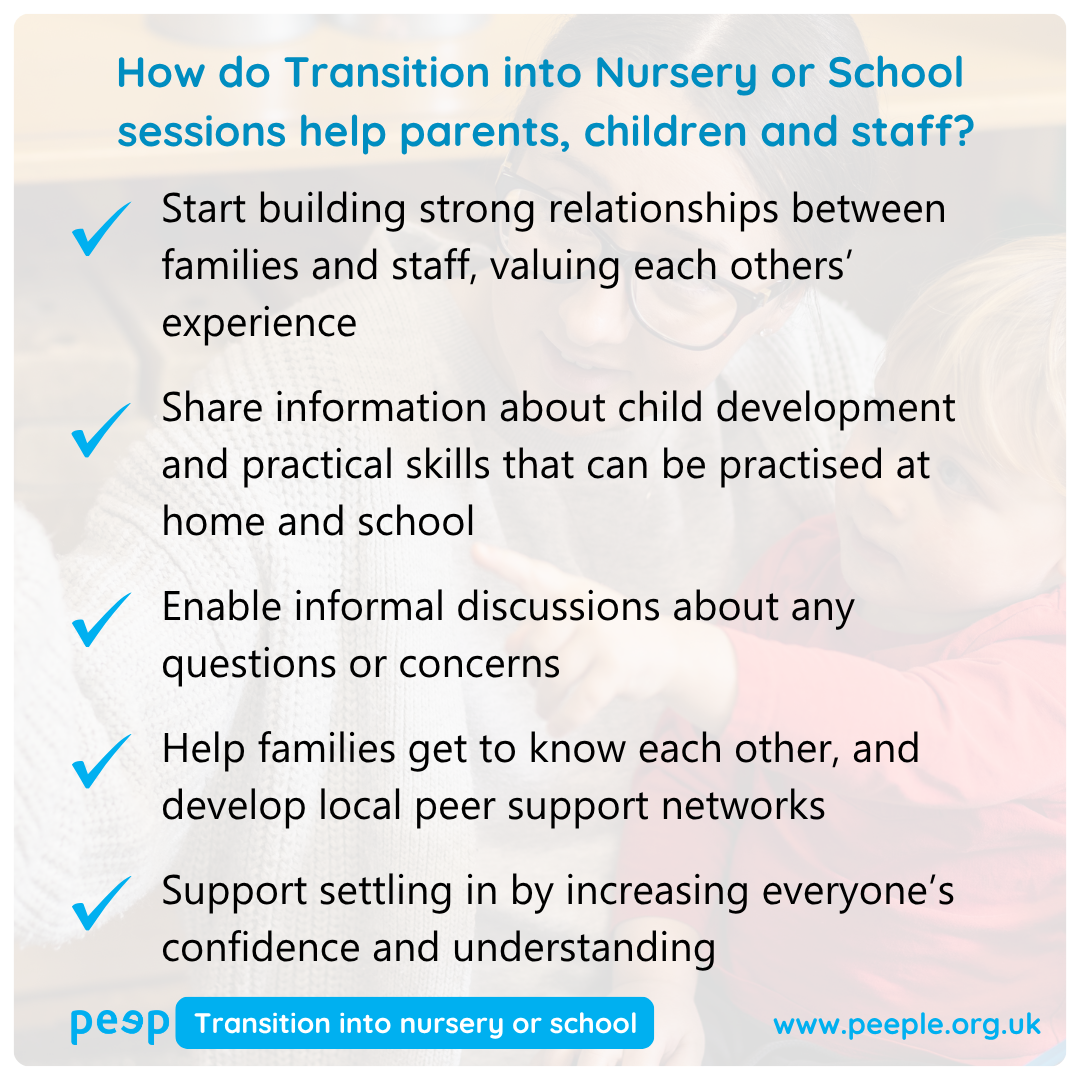 Arranging transition sessions for children and parents can feel like the early years sector equivalent of 'eat more veg': everyone agrees they’re a good idea, but fitting them in can be hard. The good news is that they’re do‑able, and they pay off - especially when they’re planned to work for families and staff.
The weeks before a child starts nursery or school are a unique window to start building a partnership that lasts all year. Much of getting ready to start at their school or nursery setting happens at home in everyday moments - talking about what will be different, practising routines, building independence. When adults feel confident and connected, children tend to settle faster and learning becomes more joined up.
Some settings already run parent-and-child Peep transition groups and swear by them. Others would like to, but face constraints. If you recognise any of the barriers below, you’re not alone:
- There isn’t time to add in 'one more thing'.
- We’re trained to work with children, not adults - it can feel daunting.
- Children will visit anyway, so we’ll see parents briefly then.
- What would we do or talk about?
- Who looks after the other children, and where would we hold it?
- We’ve invited parents before and uptake was low.
- We don’t yet have buy‑in from colleagues or senior leaders.
And yet, done well, a handful of sessions can save time later, build trust early, and give families simple ways to support learning and independence at home. That’s where the Peep Learning Together Programme (LTP) and practitioner training can help - by offering structure, materials and a tried-and-tested approach.
How Peep can help you make transition sessions workable
1. Time: it’s an investment, not an 'extra'
Time is often the biggest sticking point. But the cost of not supporting transition is real too. The latest School Readiness survey of over 1,000 school staff and 1,000 parents (Kindred Squared, 2026) reports: “Primary school staff estimate that children are missing out on 2.4 hours of daily class teaching time due to the catch‑up needs of children who are not ready for Reception.” Staff said this time is largely spent on social skills, emotional regulation and communication and language, alongside early literacy, self‑care and physical development. These things are all covered within the Learning Together programme.
A few welcoming, well‑structured sessions won’t solve every challenge - and some children will need longer‑term support - but they can shift the dial. Peep transition sessions create space for practical problem‑solving (“We tried X but…”) in a friendly, non‑judgemental group. Families leave with realistic ideas to practise at home, plus encouragement from staff and other parents.
2. Working with adults: knowing what to do (and what to say)
It’s common to feel more confident with either children or adults. Peep Learning Together training tackles this directly, and the programme gives you ready‑to‑use session plans - including talk time prompts for adults and ideas for songs, stories and simple activities to do together. You can share key information about your setting, but it’s also a chance to listen, notice worries early, and follow up if you don’t yet have an answer.
Peep handouts translate child development into everyday, doable practice: short ideas families can weave into normal life (getting dressed, snack time, story time, walking to school) - plus a simple 'why this helps'. This keeps the focus on progress, not pressure.
3. Logistics: staffing, space and fitting it around what you already do
Sessions are typically around an hour. Depending on cover and ratios, they can be led by the class teacher, a teaching/learning support assistant, or a nursery key person (with their key children attending). In some areas they’re delivered or co‑delivered by a Peep‑trained family support worker from a family hub, community organisation or local authority. They can run in the classroom, a spare room, or a local community space - and can be timed to align with existing visits (for example, feeder setting visits or when current classes are visiting their new teacher/classroom).
4. Helping parents to come along
- Make the invitation personal: a quick chat at pick‑up (of siblings or by staff at a feeder setting), a phone call, or a friendly message alongside the formal letter/email.
- Explain the 'why' in plain terms: this is about making day one easier and building routines gradually, not judging parenting.
- Remove small barriers: clear times, what to expect, whether siblings can come, and who to talk to if attendance is tricky.
- Once sessions become 'what we do here', uptake often improves year on year.
What families and staff gain from doing this early
Transition sessions help staff and families get to know each other as people, taking the edge off the first day. Children can explore and play in a safe, familiarising way, and families can practise a few key routines at home between sessions - building confidence, resilience and growing independence. Staff also learn early what helps and hinders for each family.
Parents can share what they know about their child - interests, worries, strengths, what works at home. It’s also a chance to reinforce that 'school readiness' is a shared effort: settings adapting for children as well as families practising helpful habits. Reassurance matters here, particularly (but not only) for children with special educational needs/additional support needs: development varies, and the goal is steady progress, with sensible adaptations and signposting where needed.
“The Peep group gives me lots of ideas about how to better support my daughter out with the setting” Parent
Settings using Peep Learning Together to underpin 'getting ready' sessions consistently report that children settle more quickly, parents feel more confident and engaged, and staff gain richer insights into children’s interests and needs - making learning feel more continuous between home and setting.
Getting buy‑in (and keeping it realistic)
At its heart, Peep is relationship‑based, low‑cost and flexible. It strengthens the home learning environment (shown repeatedly to improve children’s outcomes) without adding pressure, values parents as partners, and gives staff a clear structure for early connection. If you’re weighing up whether it’s worth it, consider starting small: a short series of sessions, a consistent welcome, and a few shared routines that families can practise between visits.
When transition is approached as a shared journey, everyone benefits - children, parents and practitioners alike.
“Peep gives us a shared language. Parents see that learning doesn’t just happen in school, and we see the expertise families already have.” Practitioner
“Learning is most successful when parents/carers and teachers work in partnership – and Peep supports this shared journey.” Headteacher
Getting started
- If you’re a Peep-trained practitioner - see our online guidance on transition topics and sessions. We’ve recently added more suggestions, linking to the new guidance from Kindred Squared and the DfE: ‘Starting Reception – related Peep LTP topics’. (‘Reception class' in England and Wales is for four to five year olds, usually the first year of primary school.)
- If you’re new to Peep – contact us to find out how the Peep Learning Together Programme and Training can support your transition offer.
Feature box colour:
Side Quote Color:
Peep Families Connect Training
Body:
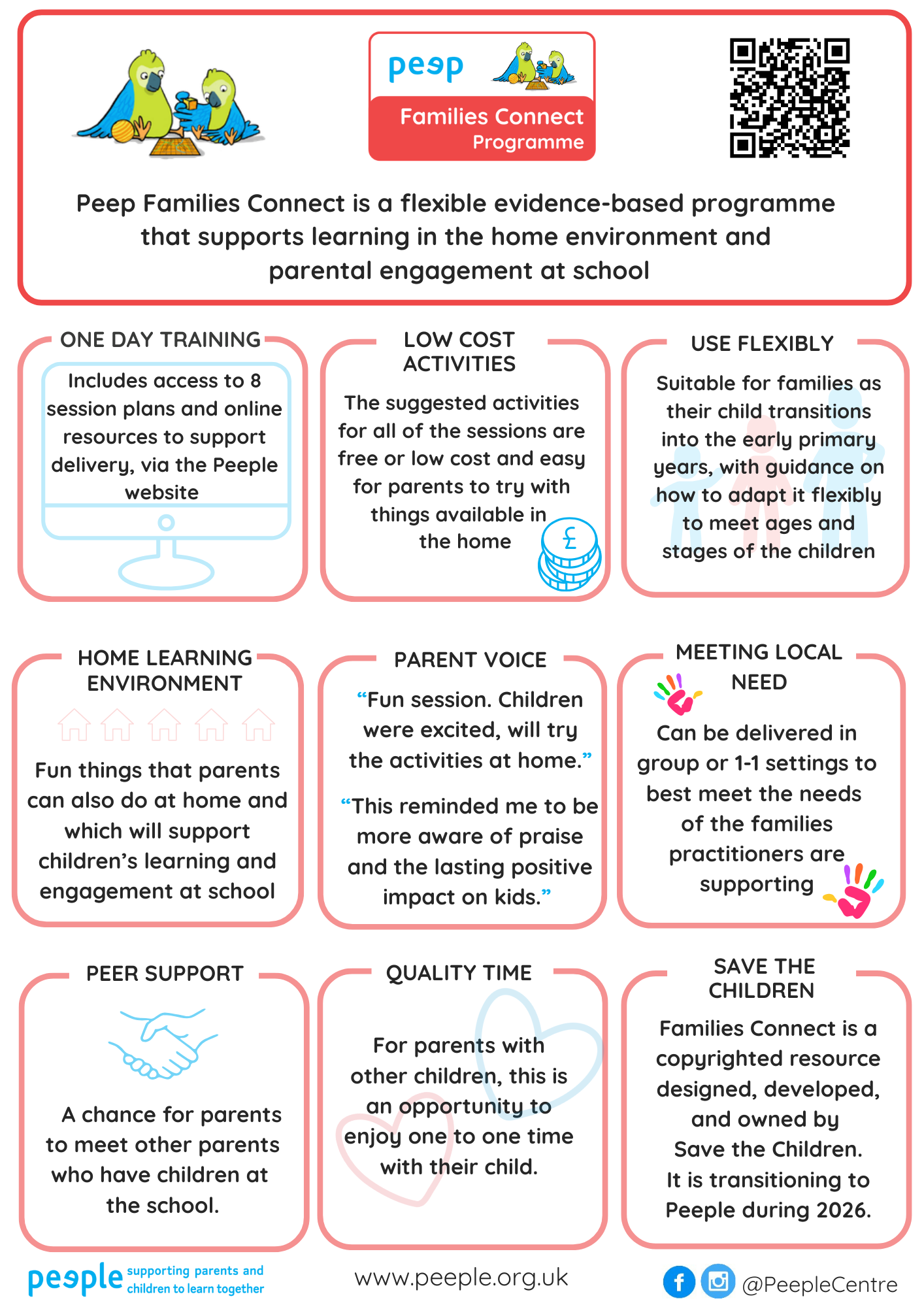
Peep Families Connect is a flexible evidence-based programme for using with parents of 3 - 7 year olds, to support their learning at home and in educational settings.
Aims – the Peep Families Connect Programme Training equips practitioners to:
- use the programme as a flexible way to engage parents and build their confidence in using the programme's ideas and simple activities to support their child's development
- expand your knowledge and skills in engaging and working with parents and carers
- deliver Families Connect sessions with parents and children together, in one-to-one or group sessions
During the training: You will explore practical delivery ideas, strategies and resources, using the Peep Families Connect Programme. The training values and builds on your knowledge, skills and experience.
Online access to Peep Families Connect Programme resources: The training includes online access to the programme, full of practical ideas and activities. It contains eight group or 1-to-1 sessions, along with handouts, tips and video clips for you to share with parents and their children.
Families Connect is a copyrighted resource designed, developed, and owned by Save the Children Fund. During 2026 the Programme is transitioning from Save the Children to become a Peep programme, ensuring its long-term future. At Peeple, we share Save the Children’s commitment to giving every child the best start in life, with a particular focus on supporting under-resourced communities. Families Connect is a natural fit within our approach. The overall ethos, structure, aims and session topics will remain the same. We have reviewed some aspects including the training, and we look forward to sharing it with practitioners and families.
Who the Training is for:
Peep Families Connect is for any practitioners working with parents of 3 to 7 year old children, including in education and childcare settings or schools.
- If you attended the original Save the Children Families Connect Training: we are offering free refresher training for previously-trained practitioners who register with us by 1 May 2026. You can then attend this one-day training on any of the online refresher courses running before 1 May 2027. We will be contacting all organisations with staff who attended Save the Children's Families Connect Training. You will need to attend this training to access the updated programme resources.
- If you or your colleagues are new to the Families Connect Programme: you can book onto one of our open courses - or arrange your own in-house course - from 1 August 2026.
Peep Families Connect aligns with our other Peep Programmes and Training, focusing on the why, what and how of supporting parents with their children’s development in a fun and flexible way. You can attend whether or not you have attended any other Peep courses.
Duration:
One day: 9.30 - 4.30pm
Training price:
£245 + vat per person, including online access to to all the planning and delivery resources
How to book:
> Check course dates for open courses then complete and return the Booking Form for Peep Families Connect Training
> Download our Peep Families Connect Training flyer for practitioners
> Find out about arranging your own in-house training course (online or face-to-face)
> Find out about a free Information session for managers
For online courses: We use Microsoft Teams. Delegates should each have a laptop/ computer or tablet to use, at home or at work; if this is a problem please contact us in advance.
Please book and send delegate details at least 14 days before the course, to ensure that your training delegate pack reaches you in the post in time.
Payment and Cancellation Terms and Conditions: Peep Learning Ltd, the trading arm of Peeple, will invoice you after receiving this booking form. Payment is due within 30 days of invoice date. Fees are only refundable if cancelled more than two weeks before the course.
Peep Learning Ltd Vat Registration no: 768 4173 94.
Contact us with any questions: [email protected] or tel 01865 397970
Feature box colour:
Side Quote Color:
Blog: Screens, tantrums and young children’s brain development
Body:
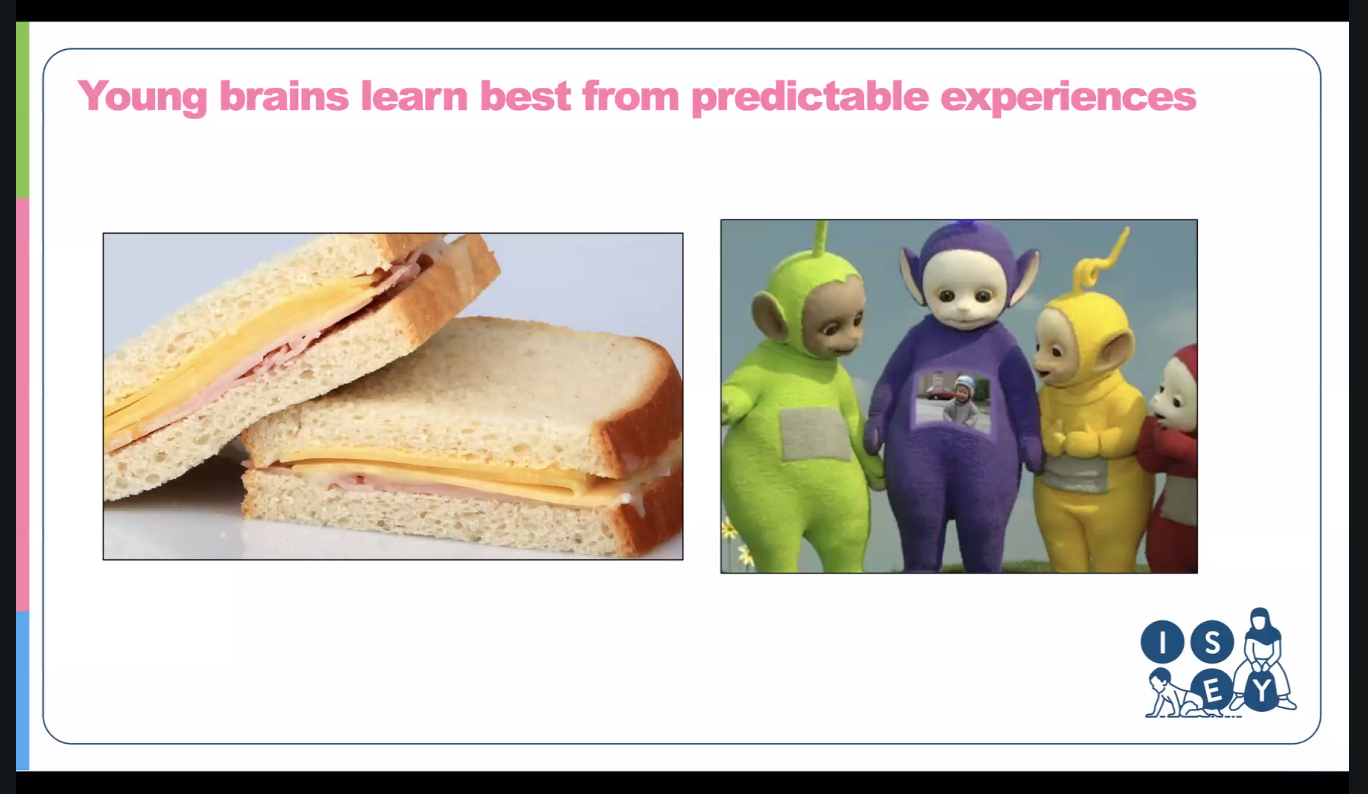 Screens are everywhere, and for families with young children they can feel both like a lifeline and a worry. The latest neuroscience indicates that young brains learn best from slow-paced, repetitive and predictable experiences. But screens often grab attention by being fast-paced and unpredictable. So how do we make sense of this, without adding yet another thing for parents to feel guilty about?
This was a key theme in Professor Sam Wass’s enlightening talk at the Learnus Annual Lecture. Drawing on his experience as a dad of three young children, as well as his role as a Developmental Cognitive Neuroscientist leading a team of researchers, he recognises how challenging it can be to resist the siren call of the screen.
It’s a contentious subject for families, and for everyone working with them. Screens can give parents a precious window to get things done, or simply to catch their breath. And most parents already feel under pressure to get things “right”.
But knowledge can be empowering. Here are three takeaways from Sam’s lecture that can help us understand more about how babies and young children learn.
1. Young children process information much more slowly
When watching something on screen, adults can process around ten frames per second. An 18-month-old can only process around one frame per second. What feels painfully slow, or even boring, to an adult is actually far more accessible for a young child. Teletubbies and In the Night Garden got the thumbs up. Slow, simple and calm really matters. Hopefully other children’s TV producers will pick up on this neuroscience and follow suit.
What this means in practice: slower-paced content, and slower-paced interactions, support learning far better than fast, flashy ones.
2. Repetition really is a good thing
In our Peep groups, parents often talk about their child wanting the same story, song or game again and again. For the adult, this can feel boring, or even worrying - why is their child not moving on? But as the lecture pointed out, repetition is a crucial part of how young children learn. Each time, they notice something new and build on what they already know.
What this means in practice: if your child wants the same book for the fiftieth time, they are not stuck. They are learning.
3. Predictability helps children feel safe and calm
Children learn best through highly predictable interactions. When their environment, whether on screen or in real life, is constantly changing and unpredictable, it can raise stress levels and put them on high alert. This can sometimes show up as big emotions after screen time. When either children or adults feel stressed, it can quickly become a cycle, with everyone feeling a bit more tetchy.
What this means in practice: predictable routines and familiar interactions help bring stress levels back down.
While modern life will always include lots of fast-moving and unpredictable moments, it’s worth protecting calmer, slower ones where we can. Simple routines at bedtime or nappy changing. Building up a bank of familiar songs. And yes, grinning through yet another reading of their current favourite book, and noticing how your child slowly begins to join in.
Sharing ideas and experiences with other parents can also help. The Learning Together Programme topic ‘Making the most of technology’ can be a good starting point for a discussion in a Peep group.
There’s no easy answer to this issue, but it’s not about guilt-tripping parents or banning screens. It’s about balance, understanding more about how young children learn, and giving ourselves permission to slow things down.
With thanks to Learnus and Professor Sam Wass. Any errors are ours - the lecture will be available to watch on the Learnus YouTube channel.
Feature box colour:
Side Quote Color:
Peep Families Connect Programme
Body:
Families Connect is a well-established, evidence-based programme for practitioners to use with 3-6 year olds and their parents and carers. It was designed to strengthen parent-child interactions, relationships between parents and settings, and early learning outcomes. It has supported thousands of families by helping parents develop practical skills to support their children's literacy, numeracy, and emotional development in the home learning environment.
 We are thrilled that Families Connect, developed and delivered by Save the Children since 2014, will be transitioning to Peeple as part of our portfolio of programmes supporting parents with their young children's development. This marks an exciting new chapter for Families Connect, ensuring its long-term future and continued impact on children and families across the UK and beyond.
At Peeple, we share Save the Children’s commitment to giving every child the best start in life, with a particular focus on supporting under-resourced communities. Our mission is to work in partnership with parents and professionals, valuing and building on their knowledge, skills, and confidence to embed high-quality early learning experiences in everyday life. Families Connect is a natural fit within our approach, and we are excited to build on the incredible foundation that Save the Children has created over the past decade.
“We are delighted to be working with Save the Children to support the delivery of the fantastic Families Connect Programme in Scotland and Northern Ireland. Then in July 2026 Families Connect will join Peeple’s portfolio of programmes which help parents to make the most of play and learning opportunities in everyday life." Dr Sally Smith, CEO, Peeple
“Families Connect has been a key element of our work in the UK for 10 years, positively impacting thousands of children and families, and we are excited it has found a long-term home with Peeple. We look forward to seeing the lasting impact of the programme in the years to come.” Dan Paskins, Executive Director of Policy, Advocacy & Campaigns, Save the Children UK
If you have any questions, please get in touch: [email protected]
Feature box colour:
Side Quote Color:
Peep TALK in Barking and Dagenham Family Hubs
Body:
In early 2025, Barking and Dagenham Family Hubs introduced Peep TALK groups, extending the Peep Learning Together sessions they were already offering to families with children from birth to four. Delivered by Early Language and Communication Workers, the groups also attract many families who speak English as an additional language.
Parents and practitioners consistently comment on how enjoyable and supportive the sessions are, with parents saying they feel better equipped to help their children’s language development at home. Follow-up assessments show the impact: 97% of participating children made progress in their communication skills.
Early Years Specialist Speech and Language Therapist for Barking and Dagenham Family Hubs, Leanne Lampen, shares why Peep TALK works so well:
"Grounded in everyday interactions:
One of the strongest aspects of Peep TALK is its focus on children’s communication happening naturally in the home environment. From a speech and language therapist’s perspective, we know that structural therapy programmes alone are less sustainable unless parents and caregivers feel confident and enabled in those everyday interactions. Peep TALK gives families practical ways to embed communication-rich moments into daily routines.
 Strengths-based with parent and child together:
The programme is designed for parents and their little ones to work together. It promotes a positive and interactive way of working with families, building on the things they already do. That means families feel valued, not judged. I often see parent anxiety around language delay; this kind of approach helps to reduce the anxiety and replace it with agency and empowerment.
Flexible early intervention:
The fact that Peep TALK is a first intervention or for families awaiting speech and language therapy is a real asset. This means we can intervene earlier, embed the right messages, and increase the likelihood of better outcomes - before difficulties become entrenched.
Evidence-Informed, practitioner-friendly resources:
Peep TALK was developed in collaboration with Speech and Language Therapists. From the therapist side this is huge: the language is right, the targets make sense developmentally, and we’re not having to retrofit a ‘generic parenting programme’ to communication needs. The support materials – ‘Talking at Home’ handouts, video clips, etc – are exactly what busy parents and practitioners need.

My observations from practice:
- Increased parental understanding: Families who attended the sessions demonstrate clearer awareness of how their interactions shape language development – for example, describing what their child is doing, giving the child time to respond, rather than a barrage of questions.
- Parent confidence increases noticeably. I’ve seen families report they feel more relaxed about their child’s communication growth, and more empowered with ideas for language-rich interactions.
- Continues in day-to-day life: There is improved carry-over into everyday routines: mealtimes, bath times, play times become language opportunities rather than a separate ‘therapy slot’. This is sustainable and realistic for families.
- Intervening early: Because the programme is flexible, we’ve been able to integrate it into mainstream early years settings and community hubs – supporting our aim of universal early years communication promotion rather than waiting for referral to a speech and language therapist (SALT).
In short, as a practitioner deeply invested in early years speech, language and communication, I wholeheartedly back the Peep TALK programme. It aligns beautifully with best practice, SALT frameworks, strengths-based, family-centred approaches, and the real-world demands of busy parents. I’m excited about the difference it is making and look forward to continuing to embed it across our settings. We really love Peep TALK, it’s incredibly effective and every day we see the change it is making."
 Our thanks to Leanne Lampen, to Susan Cummins, Early Year Language and Communication Team Manager, and to the practitioners and families from Barking and Dagenham Family Hubs
> Find out more Peep TALK Training so you can use the programme with families in your community.
Feature box colour:
Side Quote:
> Find out about Peep TALK Training for practitioners
Side Image:
Side Quote Color:
How Peep programmes support Family Hubs to achieve the best start for life
Body:
The UK Government has committed to extending Best Start for Life Family Hubs to every local authority in England, with the key target of 75% of 5 year olds reaching a Good Level of Development (GLD) by the end of the Early Years Foundation Stage (EYFS).
Peep Learning Together is an evidence-based programme that directly supports this target. Already used by half of the 75 Family Hubs in receipt of the first round of Best Start funding, the Peep Learning Together Programme offers engaging content to share with parents, flexible delivery and sustainability – helping make the most of children’s earliest years so that they can thrive.
What is the Peep Learning Together Programme?
Peep supports practitioners, parents and carers to boost babies’ and young children’s development through everyday activities in the home learning environment. It has a strengths-based approach, valuing what parents already do, and building their confidence to do more.
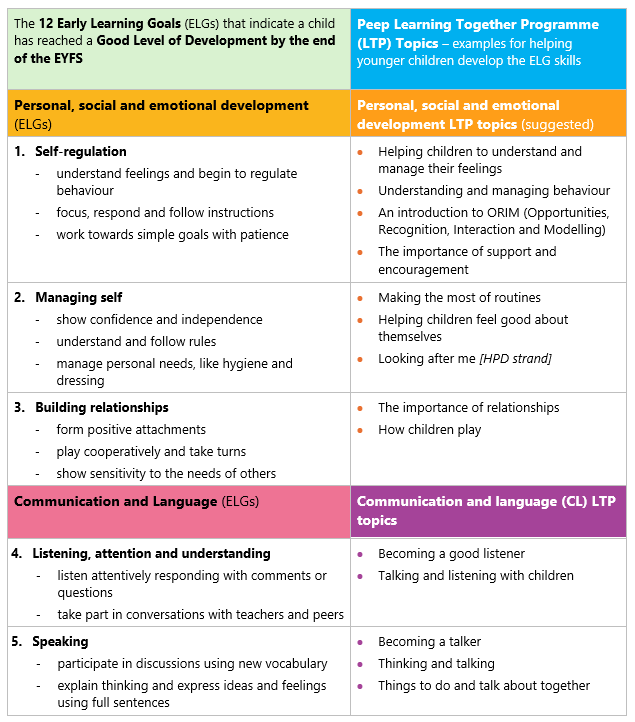
The programme covers five key strands of development: Personal, Social and Emotional Development, Communication and Language, Early Literacy, Early Maths, and Health and Physical Development. It provides practitioners with 74 downloadable topics with related session plans and parent handouts. See below for a list of Peep Learning Together Programme topics mapped to the Early Learning Goals.
Learning Together uses the ORIM framework (Opportunities, Recognition, Interaction, Modelling) developed by Professors Cathy Nutbrown and Peter Hannon, to help strengthen relationships and build positive home learning environments.
How Peep helps Family Hubs
Improving children’s outcomes and school readiness:
- Independent evaluations by the universities of Oxford, Queen’s Belfast and Warwick found significant improvements in children’s development and parental engagement for families attending Peep groups, with the greatest impact for children from less advantaged backgrounds.
- The partnerships between Peep, parents and practitioners support more children to arrive at school keen to continue exploring, developing and learning, helping to narrow the attainment gap.
Supporting parents as first educators:
- Peep sessions raise parents’ and carers' awareness of how everyday interactions support brain development.
- Peep increases parental confidence and understanding in supporting their child's play and learning at home, in simple, low-cost or no-cost ways
- Parents get to know and trust each other, developing peer support networks, reducing isolation and strengthening communities.
Workforce development:
- Peep training works well cross-sector, for example for staff from education, health, social care and family support - anyone working with parents or young children. Peep sessions currently run in a variety of settings, from Forest Schools to prisons.
- The key information and ideas in each of the 74 child development topics provide practitioners with reminders for familiar topics and build knowledge for less familiar subjects
- Organisations highlight Peep’s role in engaging families, strengthening transitions into school and multi-agency collaboration.
- On-going CPD is provided through accreditation, Peep Champions and peer support networks, online support, refresher training and resource updates.
Value for money:
- Peep training is high quality and provides on-going online access to Peep programme resources.
- Practitioners can use Peep programmes in universal and targeted approaches, encouraging early intervention that helps reduce later issues.
- Peep can be delivered flexibly, across groups, drop-ins or one-to-ones; indoors, outdoors or online. The comprehensive content of the Learning Together Programme enables you to tailor it to the needs of your local families, with any number of sessions.
“Peep is fantastic for involving parents in their children’s learning. It gives parents more confidence to support their child’s learning and take it forward at their child’s pace and development level.” – Children’s Centre Family Support Worker
Find out more:
> Join us for a free information session about using Peep programmes in your area, or watch our video
> Read how Hackney's Children and Family Hubs are using Peep programmes with local families
> 'Early Learning Goals mapped to the Learning Together Programme' - the first five are shown below, or click the link to see all twelve.
Feature box body:
Find out how Peep programmes support Family Hubs
Feature box colour:
Side Quote:
Peep group, Hackney Children and Family Hubs
Side Image:

Side Quote Color:
Blog: Working with parents and young children to help them reach a Good Level of Development
Body:
The Department for Education has set a milestone: by 2028, 75% of five-year-olds in England should reach a ‘Good Level of Development’ (GLD) when they start Year 1 – up from 68% now. That’s encouraging news for children, families, schools and wider society, showing how important the early years are for giving every child the best start.
Best Start Family Hubs are expanding across England as one of the key ways to achieve this. They highlight the importance of parents and carers working alongside practitioners across early years education, health and family support. This approach builds on the evidence from Sure Start Children’s Centres and decades of research on the huge benefits of early support during the first five years of brain development.
At Peeple, we know that working together with parents – recognising their knowledge and experience, and building their confidence in supporting their child’s learning – makes a real difference to outcomes. This is especially powerful for children from less advantaged backgrounds, as shown in the Peep Learning Together RCT Study, helping to narrow the attainment gap and improve opportunities for all children.
The 12 Early Learning Goals that make up a Good Level of Development sit within five key areas of children’s learning. These are basically the same five strands of development covered by the 74 topics in the Peep Learning Together Programme (LTP); the additional wording in the LTP strands is in brackets:
- Personal, social and emotional development
- Communication and language
- (Health and) Physical development
- (Early) Literacy
- (Early) Maths
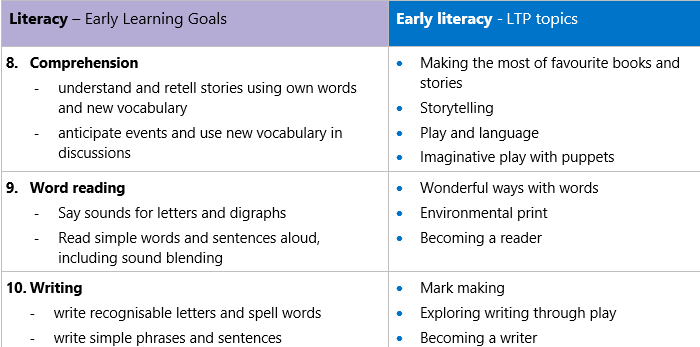 We’ve mapped the 12 Early Learning Goals to related Peep Learning Together Programme topics. Here’s an example of how the Literacy goals connect with Peep topics:
You can explore the full list for all 12 goals in the LTP section of our website.
Want to find out more?
> Join us for a free online Information session or watch our video
> Find out about Peep Learning Together Programme Training for practitioners – you can book an in-house face-to-face or online course or individual places
Feature box colour:
Side Quote Color:
Early Learning Goals mapped to Peep Learning Together topics
Body:
The table below shows Peep Learning Together topics for using with parents and their toddlers and young children. We've suggested various topics that would help them achieve the government's early learning goals (for England) listed opposite. The goals are from the Early Years Foundation Stage (EYFS) and aim to lead to the government's 'good level of development' milestone when children are five and are starting school. These are only suggestions - you're welcome to choose other topics.
We hope you'll find the list helpful in your planning if you're focusing on any of these areas - whether or not your work is in England or relates to the EYFS.

Find out more:
> How Peep programmes can support the EYFS, Family Hubs and the Best Start for LIfe
Feature box colour:
Side Quote Color:
Children and Family Hubs: Hackney
Body:
From 35% to 99%: How Hackney's Children and Family Hubs are using Peep to work in partnership with parents to build confidence in supporting their children
 In Hackney, the Peep Learning Together Programme is transforming how families support their children’s early development. Local practitioners are working in partnership with parents to improve their confidence in making learning a part of everyday life. The results are striking: over the past year, parents have reported big leaps in confidence and home learning activities, underlining the measurable impact of the programme.
Strong partnerships across Hackney
During the year to March 2025, Hackney practitioners ran six-week Peep Learning Together groups in 26 children’s centres, hubs, nurseries and schools across the borough. 216 families attended the groups, mostly with three to four year old children. Nearly two-thirds lived in areas of high deprivation. Attendance was excellent, with families attending on average five out of six sessions. This level of engagement reflects the strong relationships formed between practitioners and parents.
Impact on parental confidence and home learning
The outcomes are striking:
- Parents’ confidence about supporting their child’s learning and development rose from 35% before Peep to 99% afterwards.
- 94% said Peep helped them support their child’s early language development.
“Since doing these activities, I have noticed a change in his speech and he expresses his feelings more than before. I use the ‘5 steps’ and it helps me understand my child more and he understands me more too.” Parent, Comet Nursery & Children’s Centre
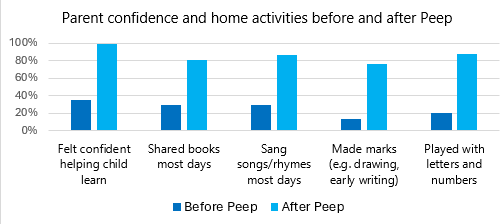
Everyday home learning activities also increased dramatically:
- Reading or sharing books rose from 29% to 81%
- Singing songs or rhymes together up from 29% to 87%
- Making marks and playing with letters and numbers saw similar increases.
Finding these opportunities to play and learn together has other important benefits. 88% of parents reported a positive difference in their relationship with their child after the programme.
“During play activities, we talk more about what we are doing and expand our language. Showing more interest has developed our relationship even more than I thought it could.” Parent, Little Buds Day Nursery
Peer support and practitioner reflections
One of the things that makes Peep groups most effective is the combination of the Learning Together Programme being delivered by caring and skilled practitioners, with parents who are willing to join in and have a go. They create a safe space for families to support and learn from each other.
“It has been really helpful to voice anxieties and express opinions and learn more from other parents at a similar stage.” Parent, Mapledene Children’s Centre
“I liked everything about Peep. I get to learn from other parents as they share their experience and also things they do with their child/ren. I like how the coordinators do their things.” Parent, Rainbow Nursery
Overall, as both parents and staff found, a little can go a long way.
“The parents enjoyed the interactive sessions. They have become more aware of the kind of language to use around their children to help support and expand their vocabulary. Many shared how just 10 to 15 minutes of daily, focused time with their child has helped build stronger bonds and positive relationships.” Nursery manager, Rooftop Nursery
The Peep groups across Hackney's Children and Family Hubs clearly demonstrate how this partnership approach helps children to thrive. The practitioners used their skills and experience to create welcoming, non-judgmental groups for families. They selected topics from the Peep Learning Together Programme that were most relevant to their local families and parents engaged with the ideas about child development, trying things out at home and sharing their experiences with each other - their willingness was reinforced as they noticed the difference it made to their child’s talking, playing and learning, and – just as importantly – to their parent-child relationship.
Thanks to Alex Charalambous, Parenting Programmes & Home Learning Coordinator, Hackney Early Years, and to the families and practitioners involved in Peep in Hackney
Visit Hackney Council's website for more information on the support they offer for younger children and their families.
Feature box colour:
Side Quote:
find out more or book training
tel 01865 397 970
[email protected]
> information briefing
> in-house training
> training courses
> sign up to our e-newsletter
Side Image: